Service Hotline:13510328459
 205-206, 2nd Floor, Building 2, Xiazao Village Industrial Zone, Gaofeng Community, Dalang Street, Longhua District, Shenzhen City
Service Hotline:13510328459
205-206, 2nd Floor, Building 2, Xiazao Village Industrial Zone, Gaofeng Community, Dalang Street, Longhua District, Shenzhen City



Time:2026-02-26 Preview:
In the architectural design of healthcare environments, the corridor is more than just a passage—it is a lifeline. For patients recovering from surgery, elderly residents with mobility challenges, and medical staff rushing in emergencies, the presence of robust hospital handrails is a non-negotiable safety requirement.
For B2B procurement officers, construction contractors, and facility managers, sourcing high-quality handrails for hospitals involves balancing patient ergonomics with heavy-duty wall protection. At Econley, we manufacture industrial-grade safety solutions that meet international building codes while standing up to the rigorous cleaning and impact demands of 24/7 medical facilities.
The primary function of a hospital handrail is to provide stability. However, in a medical setting, these systems must perform multiple roles simultaneously: aiding mobility, protecting infrastructure, and maintaining hygiene.
Falls in hospitals are a leading cause of extended patient stays and increased liability. A strategically placed hospital corridor handrail provides a continuous "touchpoint" for patients. By ensuring the railing is ergonomically shaped for a secure grip, facilities can significantly reduce the risk of accidental slips during patient ambulation.
Hospital hallways are high-impact zones. Stretchers, oxygen tanks, and food trolleys are constantly in motion. A hospital wall guard handrail (often referred to as a crash rail) is engineered to absorb the shock of these impacts, preventing expensive damage to the drywall and reducing long-term maintenance costs.
Because they are high-touch surfaces, handrails in hospital corridors must be easy to sanitize. Econley utilizes specialized PVC/Vinyl covers treated with antimicrobial agents that resist the growth of bacteria and can withstand harsh chemical disinfectants without fading or degrading.
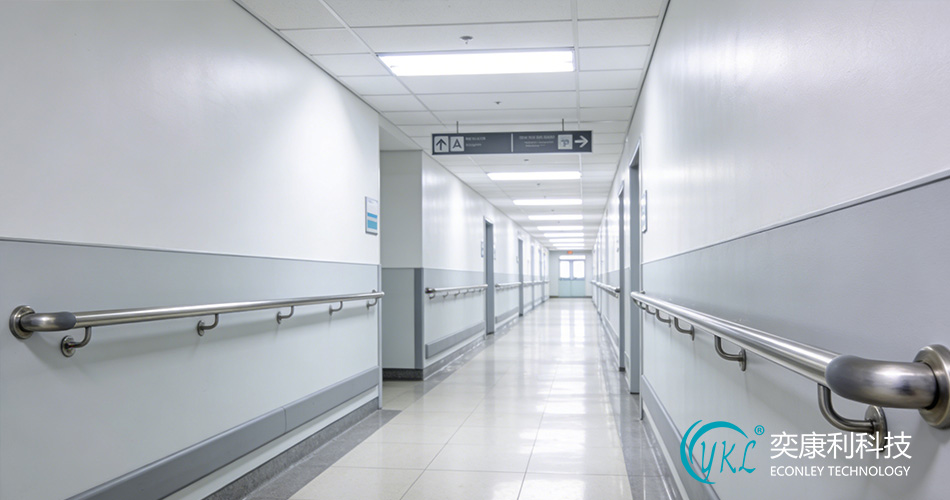
Compliance with international standards like the ADA (Americans with Disabilities Act) or local building codes is essential for any medical project. Failure to adhere to hospital corridor handrail requirements can result in failed inspections and project delays.
To ensure universal accessibility, the hospital handrail height must be precise:
Standard Mounting Height: Handrails should be mounted between 34 inches and 38 inches (865 mm – 965 mm) above the finished floor.
Wall Clearance: There must be a minimum clear space of 1.5 inches (38 mm) between the wall and the handrail to allow for a full power grip without scraping knuckles.
Continuity: The railing should be continuous, with ends that return to the wall to prevent clothing or equipment from snagging.
The modern standard is the aluminium hospital handrail with a vinyl cover.
The Aluminium Core: Provides the structural backbone. At Econley, we use 6063-T5 high-strength aluminium to ensure the rail does not sag or bend under pressure.
The PVC Cover: Provides a "warm-to-touch" surface and color-coding options. Unlike cold stainless steel, PVC is more comfortable for elderly patients and allows for "wayfinding" designs (using different colors for different hospital wings).
While corridors are the main focus, safety must extend into the patient room.
A hospital bed handrail (or side rail) is vital for preventing patients from falling out of bed and assisting them when transitioning to a standing position. These must be engineered with "zero-gap" technology to prevent entrapment. Econley supports projects by providing matching materials so that the hospital hallway handrails and bed-side safety rails maintain a consistent aesthetic and hygiene standard.
For maximum efficiency, hospital hallway handrails should feature:
Anti-Bacterial Finishes: Integrated silver-ion technology.
Impact Cushions: Internal rubber strips that absorb the "thud" of a cart hitting the rail.
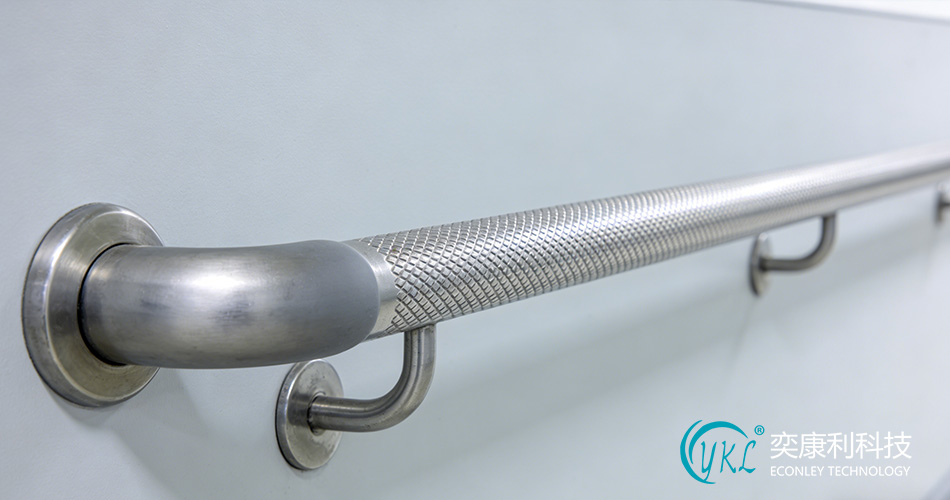
Non-Slip Texture: Subtle embossing on the PVC cover to ensure a grip even if the patient's hands are damp.
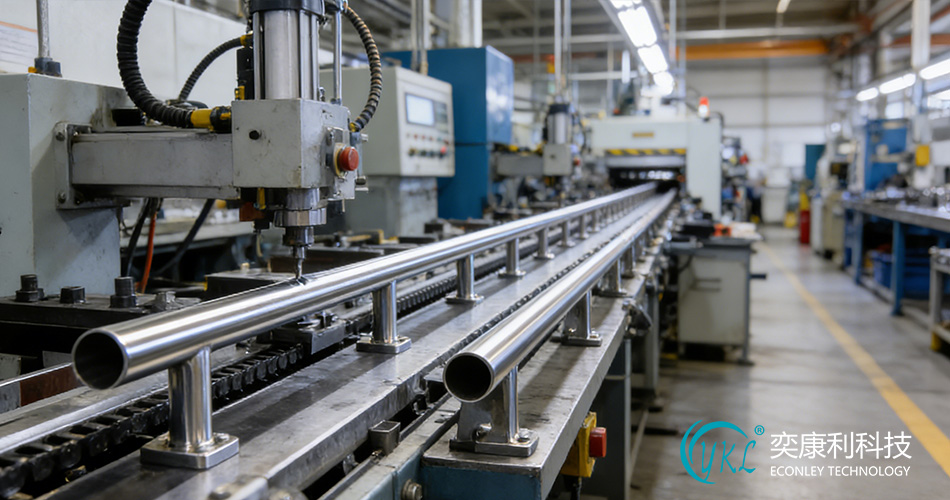
As one of the premier hospital handrail suppliers in the global market, Econley understands the "factory-to-site" workflow. We don't just supply parts; we provide engineered safety systems.
We recognize that every facility has unique architecture. Whether you need custom angles for sloped ramps or specific colors to match a corporate brand, our factory can produce Custom Corridor Handrail solutions tailored to your CAD blueprints.
By eliminating middlemen, we provide direct factory wholesale pricing. This allows contractors to secure high-specification aluminium hospital handrail systems while keeping project budgets under control.
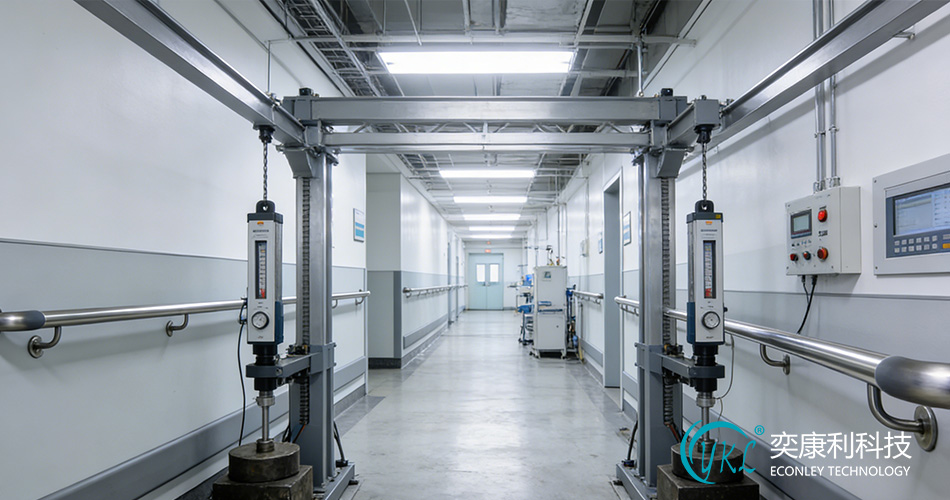
Every meter of our hospital handrails undergoes strict testing:
Load Testing: Ensuring the rail can support a concentrated load of at least 200 lbs.
Fire Rating: Our PVC covers meet Class A fire-retardancy standards (NFPA 701 or local equivalents).
Chemical Resistance: Tested against 20+ common medical disinfectants.
While Econley primarily specializes in wall-mounted corridor systems, mounting a hospital bed handrail usually involves securing a heavy-duty steel or aluminum bracket to the bed frame's structural chassis. It is critical to ensure that the mounting hardware is vibration-resistant to prevent the rail from loosening over time. For wall-mounted rails near the bed, we use heavy-duty toggle bolts to ensure the rail remains stable when a patient uses it to pull themselves up.
Yes. International building codes and ADA guidelines mandate that handrails in hospital corridors be installed on both sides of any hallway used by patients to ensure continuous support and accessibility.
The gripping surface should have an outside diameter of 1.25 inches to 1.5 inches. This size is clinically proven to be the most comfortable for the widest range of hand sizes, including those of elderly patients with arthritis.
A hospital wall guard handrail is designed with a wider profile and an internal bumper. When a bed or cart hits the rail, the impact is absorbed by the aluminum retainer and dissipated, protecting the delicate drywall behind it and preventing "gouging" or structural damage.
Related content
Hospital Curtain Tracks | Aluminum Ceiling Track Systems | Econley
Hospital Curtains: A Guide to Antibacterial & Fire-Retardant Standards
Sourcing Hospital Corridor Handrails: Wholesale Solutions for Medical Projects
Best Hospital Curtain Tracks 2026 | Durable Ceiling Track Systems | Econley
Wholesale Hospital Bathroom Curtains | Waterproof & Fire-Retardant | Econley
Hospital Divider Curtains & Tracks | Durable Medical Fabrics | Econley
 Tel :13510328459
 Email :493432861@qq.com
 Phone :0755-82154850/25907050
 Add:205-206, 2nd Floor, Building 2, Xiazao Village Industrial Zone, Gaofeng Community, Dalang Street, Longhua District, Shenzhen City

About

Products
Cases
News
Contact
 493432861@qq.com