Service Hotline:13510328459
 205-206, 2nd Floor, Building 2, Xiazao Village Industrial Zone, Gaofeng Community, Dalang Street, Longhua District, Shenzhen City
Service Hotline:13510328459
205-206, 2nd Floor, Building 2, Xiazao Village Industrial Zone, Gaofeng Community, Dalang Street, Longhua District, Shenzhen City



Time:2026-02-05 Preview:
In the modern healthcare landscape, the physical environment plays a pivotal role in patient recovery and infection management. A hospital privacy curtain is not merely a piece of fabric; it is a sophisticated medical device engineered to meet rigorous safety, hygiene, and privacy protocols.
For hospital administrators, facility managers, and international contractors, sourcing the right hospital curtains and tracks is a high-stakes decision. From fire safety compliance to antimicrobial efficacy, every detail impacts the facility's operational success. This guide explores the essential standards for hospital divider curtains and how to choose systems that ensure long-term durability and patient safety.
The primary function of a hospital room partition curtains system is to provide a flexible, dignified space for patient care. However, in a clinical setting, these surfaces are frequently touched by patients, medical staff, and visitors, making them potential reservoirs for pathogens.
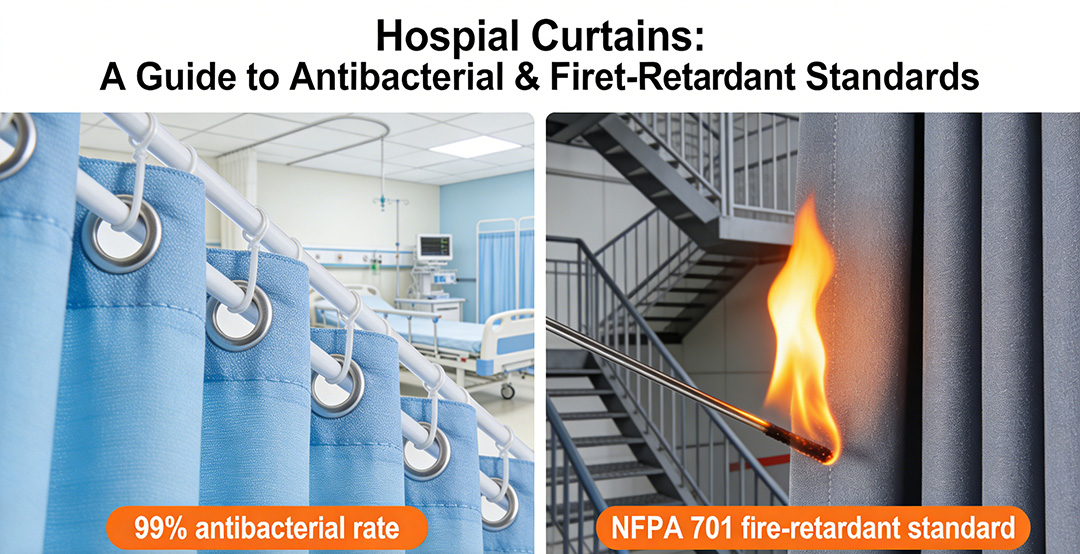
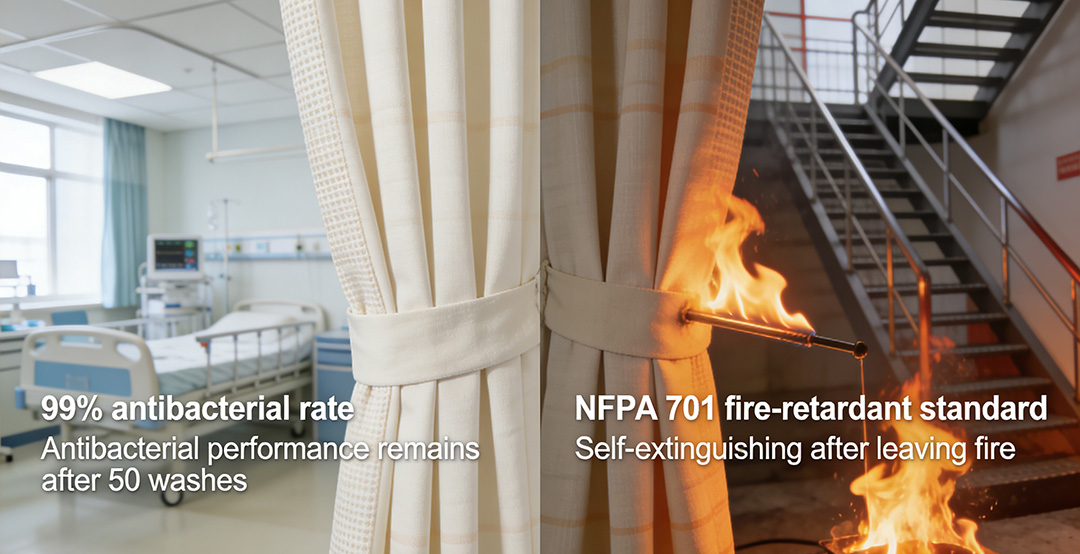
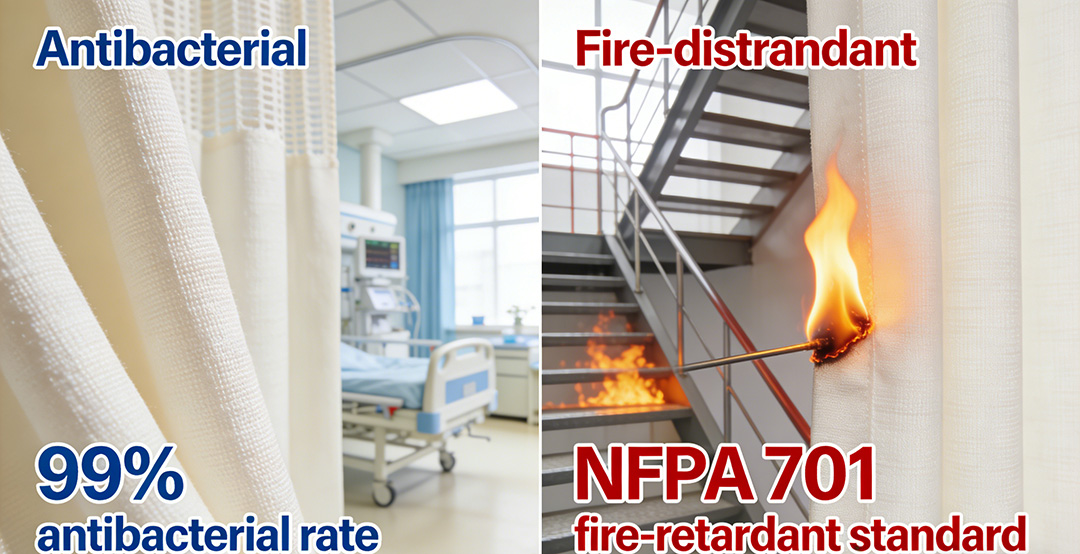
Modern antimicrobial hospital curtains are treated with specialized coatings that inhibit the growth of bacteria, mold, and fungi. By reducing the bioburden on the fabric surface, these curtains help mitigate the risk of Healthcare-Associated Infections (HAIs). When selecting hospital cubicle curtains, it is essential to verify that the antimicrobial properties are "built-in" to the fiber rather than just topically applied, ensuring the protection lasts through repeated wash cycles.
In Emergency Rooms (ER) and Intensive Care Units (ICU), where the turnover is high and the risk of contamination is extreme, many facilities opt for disposable curtains hospital staff can replace in minutes. These are typically made of recyclable polypropylene and are designed to be discarded once soiled, eliminating the need for expensive industrial laundering.
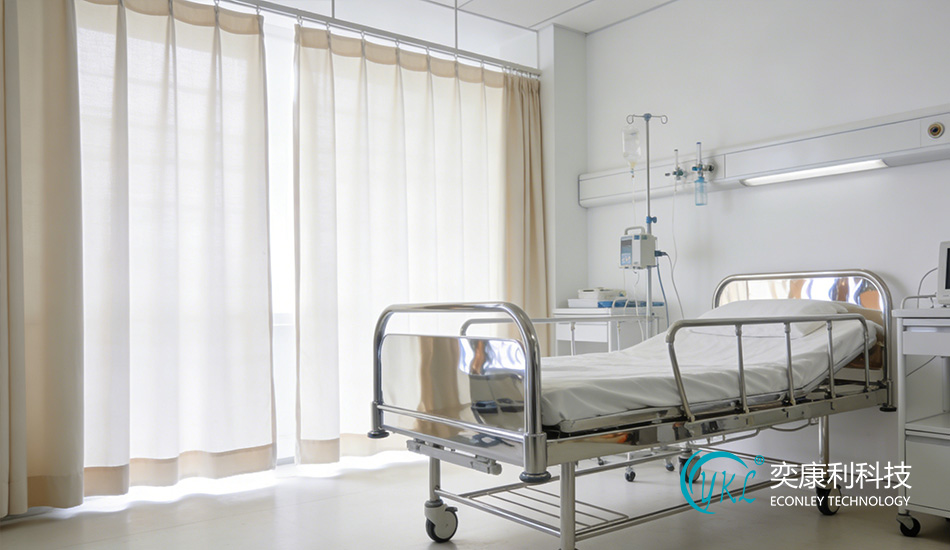
Fire safety is the most critical regulatory hurdle for any hospital room divider curtains. Because hospitals often contain oxygen-rich environments and immobile patients, the fabric must be inherently flame-retardant.
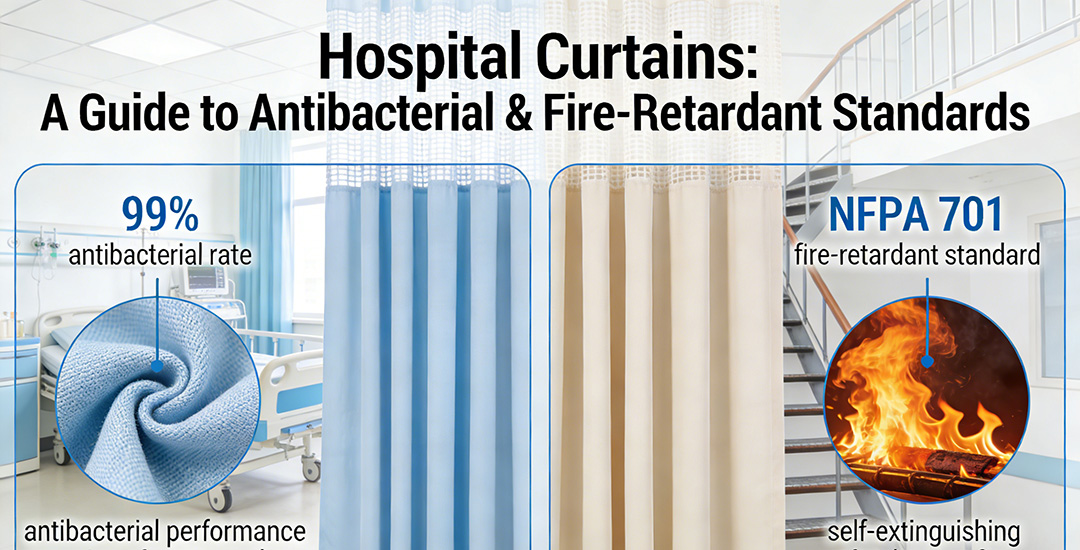
A high-quality hospital curtain+flame retardant must meet international standards such as:
NFPA 701 (USA): The most recognized standard for textile flame propagation.
BS 5867 Part 2 Type C (UK): A rigorous standard for curtains used in public buildings.
AS 1530 (Australia/Oceania): Standards for fire tests on building materials.
At Econley, our fabrics are engineered to be "Inherently Flame Retardant" (IFR), meaning the fire-stopping properties are part of the molecular structure of the yarn. Unlike treated fabrics, IFR curtains will never lose their fire rating, regardless of how many times they are washed.
A curtain is only as effective as the hardware that supports it. The hospital curtain track must provide smooth, silent, and snag-free operation to ensure patient comfort and staff efficiency.
Sourcing hospital curtains and tracks from a single manufacturer ensures compatibility. A mismatched system often leads to "sticky" rollers or premature wear on the fabric headers. Professional hospital curtain tracks are typically made of extruded aluminum (6063-T5) with a white powder-coated or anodized finish for maximum corrosion resistance.
Ceiling-Mounted: Offers maximum stability and a clean aesthetic.
Suspended: Used in rooms with high ceilings or where HVAC and lighting fixtures obstruct the ceiling path.
Curtain Hospital Room Layouts: Modern tracks allow for "L-shape," "U-shape," or "O-shape" configurations to perfectly surround the patient bed.
Different zones within a medical facility require specialized textile solutions. A hospital divider curtains system in a ward has vastly different requirements than a hospital shower curtain in a wet room.
Hospital shower curtains must be 100% waterproof and resistant to soap scum and mildew. Unlike standard residential curtains, a hospital shower curtain is usually made of heavy-duty vinyl or treated polyester that can be wiped down with disinfectants daily.
For hospital room partition curtains, the top 20 inches of the fabric usually consists of a specialized mesh.
Purpose: The mesh allows ceiling-mounted fire sprinklers to penetrate the curtain area and ensures proper air circulation from the building's HVAC system.
Privacy: While the mesh allows light and air, the solid fabric below ensures total visual privacy for the patient.
When a factory or contractor requests a quote for a hospital room divider curtains project, they should focus on the following technical parameters:
| Feature | Specification Requirement | Benefit |
| Fabric Weight | 250gsm - 320gsm | Ensures durability and opacity for privacy. |
| Track Material | 6063-T5 Aluminum | Prevents sagging and ensures smooth gliding. |
| Infection Control | Antimicrobial / Antibacterial | Reduces cross-contamination risks. |
| Cleaning | Industrial Washable (160°F) | Ensures hygiene without damaging the fabric. |
| Customization | OEM / ODM Lengths | Perfect fit for any curtain hospital room size. |
As a results-oriented manufacturer, Econley understands the pressure on contractors to deliver projects on time and within budget. We don't just supply products; we provide hospital curtains and tracks solutions tailored to your project's specific blueprints.
Manufacturing Excellence: Our facility utilizes advanced weaving and coating technology to ensure every meter of fabric meets international standards.
Quality Assurance: From the tension strength of the hospital curtain track to the colorfastness of the fabric, we perform 100% inspection before shipment.
B2B Support: We provide CAD drawings, installation manuals, and material certifications (SGS/UL) to help you win tenders and pass inspections.
In the industry, they are primarily called hospital cubicle curtains, medical privacy curtains, or nurse call curtains. They are often part of a broader "cubicle track system."
Hospitals use hospital privacy curtain systems for three main reasons: to provide visual privacy during examinations, to assist in infection control by creating a barrier, and to help manage the acoustics and light within a shared ward.
In the medical sector, the three main types are:
Standard Fabric Curtains: Long-lasting, washable, and inherently flame-retardant.
Disposable Curtains: Ideal for high-contamination areas.
Specialized Shower Curtains: Waterproof and anti-mildew for patient bathrooms.
Econley specializes in all three types to provide a one-stop sourcing experience.
A cubicle is a semi-private patient area within a ward, defined by the path of the hospital curtain track. It allows multiple patients to stay in a single room while maintaining individual dignity and space for medical procedures.
Related content
Hospital Curtain Tracks | Aluminum Ceiling Track Systems | Econley
Sourcing Hospital Corridor Handrails: Wholesale Solutions for Medical Projects
Best Hospital Curtain Tracks 2026 | Durable Ceiling Track Systems | Econley
Wholesale Hospital Bathroom Curtains | Waterproof & Fire-Retardant | Econley
Hospital Divider Curtains & Tracks | Durable Medical Fabrics | Econley
Hospital Handrails Manufacturer | ADA Compliant Corridor Safety | Econley
 Tel :13510328459
 Email :493432861@qq.com
 Phone :0755-82154850/25907050
 Add:205-206, 2nd Floor, Building 2, Xiazao Village Industrial Zone, Gaofeng Community, Dalang Street, Longhua District, Shenzhen City

About

Products
Cases
News
Contact
 493432861@qq.com