Service Hotline:13510328459
 205-206, 2nd Floor, Building 2, Xiazao Village Industrial Zone, Gaofeng Community, Dalang Street, Longhua District, Shenzhen City
Service Hotline:13510328459
205-206, 2nd Floor, Building 2, Xiazao Village Industrial Zone, Gaofeng Community, Dalang Street, Longhua District, Shenzhen City



Time:2025-12-29 Preview:
Nursing homes are dedicated to providing safe and comfortable living spaces for the elderly, most of whom face mobility challenges such as limited lower limb strength, balance disorders, or wheelchair dependence. Handrails are core safety infrastructure, but their protective effect relies on systematic and professional engineering services rather than simple installation. Nursing Home Handrail Installation Engineering Service integrates on-site planning, customized design, standardized construction, and long-term maintenance, tailored to the unique characteristics of elderly residents and nursing home operations. Unlike general building handrail installation that focuses on basic fixation, this engineering service prioritizes the elderly’s physical limitations, operational interference control, and barrier-free compliance. As a professional provider of elderly care facility solutions, we integrate Nursing Home Handrail Installation Engineering Service with core elderly-friendly products such as anti-slip flooring, emergency call systems, and elderly-specific seating, delivering comprehensive safety optimization for nursing homes. This article explores the core value, full-process solutions, scenario-specific norms, and selection criteria of Nursing Home Handrail Installation Engineering Service, offering practical guidance for nursing home management and procurement teams.
The primary value of Nursing Home Handrail Installation Engineering Service lies in providing systematic safety guarantees for the elderly through professional engineering capabilities. The elderly have unique physical characteristics—reduced grip strength, slow movement, and high fall risks—requiring handrail installation to be more precise in height, position, and structural stability. Non-systematic installation may result in mismatched heights, unstable structures, or obstacles that increase fall hazards, failing to protect vulnerable elderly groups.
Another key value is minimizing operational interference during construction. Nursing homes need to maintain normal care services during renovation or new construction; professional engineering services formulate scientific construction plans, such as arranging construction during non-rest hours, setting up protective barriers, and controlling noise and dust. This ensures that handrail installation does not disrupt the daily life of residents or the work of caregivers. Additionally, systematic engineering services optimize the overall barrier-free layout, ensuring handrails coordinate seamlessly with other facilities (e.g., ramps, elevators) to form a complete safety support system, enhancing the overall accessibility of the nursing home.
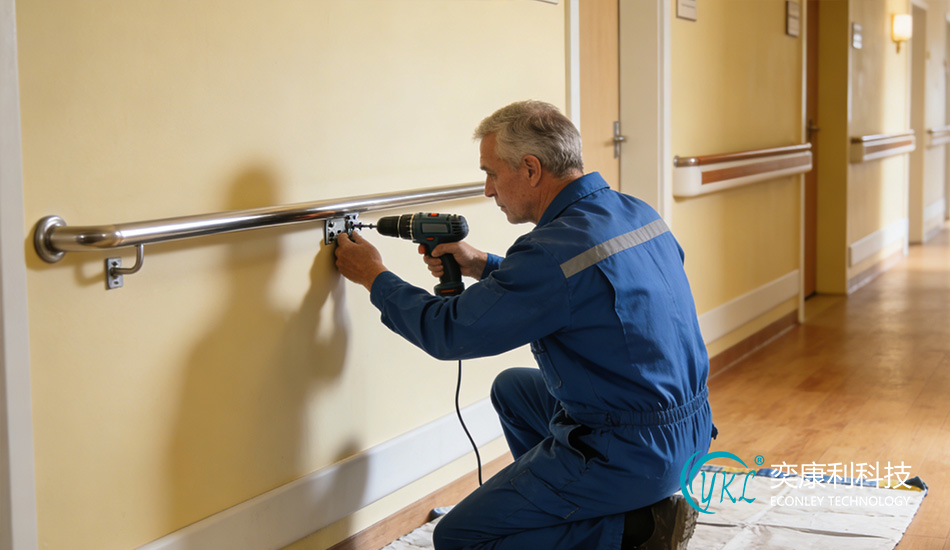
Professional Nursing Home Handrail Installation Engineering Service adopts a rigorous full-process management model to ensure quality and efficiency. The first stage is on-site assessment and customized planning: engineering teams conduct detailed surveys of the nursing home’s layout, functional zones, and resident mobility conditions (e.g., proportion of wheelchair users, patients with hemiplegia). They communicate with management teams to understand service needs and formulate personalized installation plans, including handrail type selection, installation height, layout routes, and construction schedules.
The second stage is standardized construction execution: teams use professional tools and certified materials to carry out construction in accordance with the plan. During construction, they pay special attention to structural reinforcement (e.g., ensuring firm fixation on load-bearing walls) and safety protection (e.g., avoiding sharp edges). For old nursing home renovations, they first reinforce aging wall structures to meet installation requirements. The third stage is post-construction acceptance and maintenance handover: comprehensive tests are conducted, including load-bearing tests and structural stability inspections. Teams provide detailed engineering reports, maintenance guidelines, and conduct training for nursing home staff on daily inspection and maintenance methods. Long-term maintenance services are also provided to address issues such as loosening or wear in a timely manner.
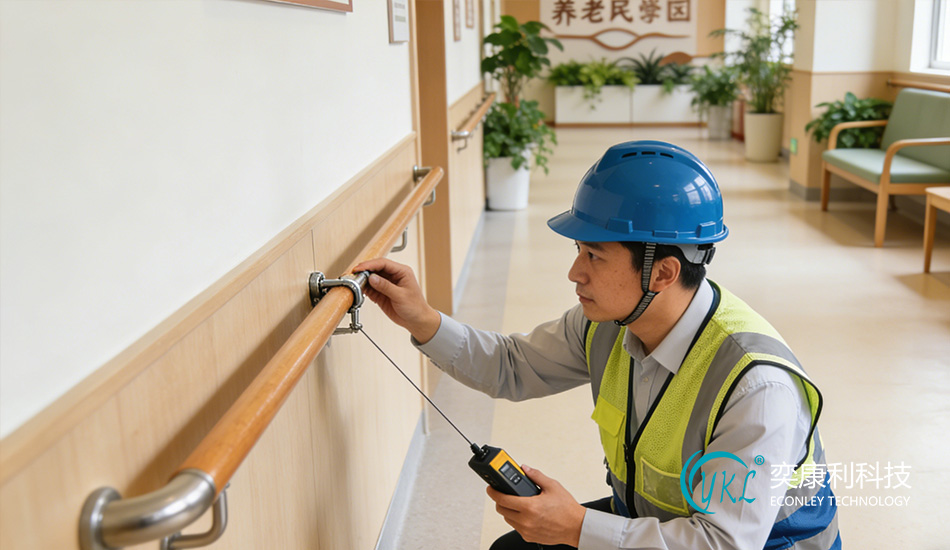
Nursing Home Handrail Installation Engineering Service adheres to targeted norms for different functional zones, fully adapting to the elderly’s daily activity needs. In bedrooms, handrails are installed beside beds at a height suitable for the elderly to get up and lie down, with extended lengths to provide continuous support during transfer. The installation position avoids obstructing bed movement or caregiver operations.
In bathrooms—a high-risk fall area—engineering teams install corrosion-resistant and moisture-proof handrails around toilets, sinks, and shower areas. They adopt reinforced fixation technology to prevent loosening caused by humid environments and adjust the installation angle to facilitate the elderly’s sitting and standing. In corridors and activity rooms, handrails are installed continuously along walls, with high-contrast color matching to help visually impaired residents locate them easily. For areas with cognitive impairment residents, handrails are installed with simple and smooth routes, avoiding complex turns and obstacles to reduce confusion.
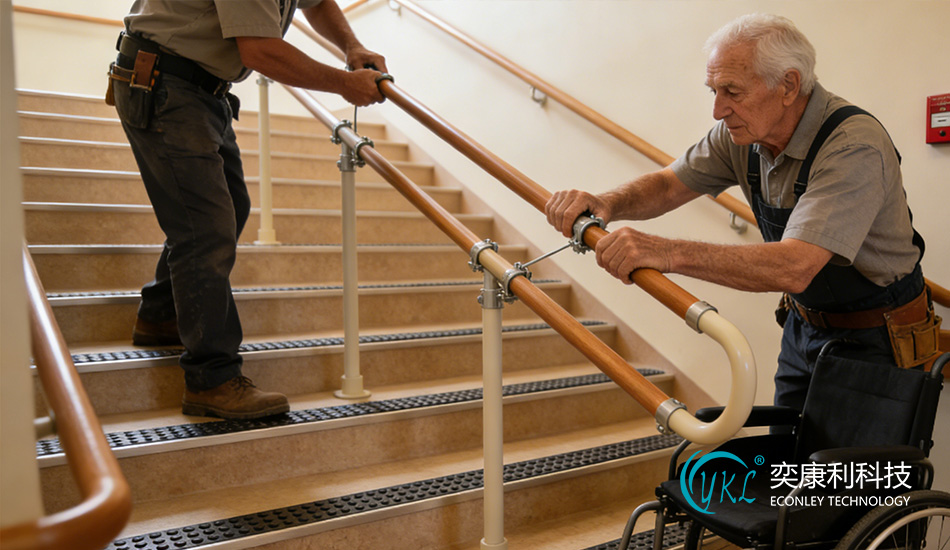
Professional Nursing Home Handrail Installation Engineering Service strictly complies with international and national elderly care facility standards, such as ISO 14122 (Barrier-Free Design for Buildings) and China’s "Code for Barrier-Free Design of Elderly Care Facilities". Engineering teams are proficient in these standards, ensuring every link from planning to construction meets regulatory requirements.
A strict quality control system is implemented throughout the project: raw materials undergo rigorous testing to ensure they are non-toxic, corrosion-resistant, and suitable for the elderly; in-process inspections focus on installation precision, structural stability, and safety hazards; post-construction acceptance includes simulated use tests by personnel matching the elderly’s physical characteristics. Complete compliance documents, including engineering plans, material certification reports, and post-construction test reports, are provided to facilitate nursing home safety audits and certification.
When selecting Nursing Home Handrail Installation Engineering Service, nursing home teams should focus on three core criteria: professional experience in elderly care scenarios, full-process service capabilities, and compliance guarantees. Firstly, verify that the engineering team has rich experience in nursing home projects, with case studies of similar facilities to prove their ability to adapt to the unique needs of the elderly.
Secondly, assess the completeness of the service system, including whether on-site assessment, customized planning, standardized construction, post-construction acceptance, and long-term maintenance are provided. Finally, confirm that the team can provide complete compliance documents and quality warranties, ensuring the project meets safety standards and the handrails maintain stable performance over time.
Nursing Home Handrail Installation Engineering Service is a critical link in building a safe and elderly-friendly environment, directly related to the safety and dignity of residents. By choosing a professional engineering service team, nursing homes can obtain systematic handrail installation solutions that fully adapt to the elderly’s needs and operational requirements. If you are a nursing home management or procurement team seeking high-quality Nursing Home Handrail Installation Engineering Service and integrated elderly care solutions, contact us today. We will provide personalized engineering plans, strict quality control, and full-process technical support, helping you create a safer, more accessible, and caring living environment for the elderly.
 Tel :13510328459
 Email :493432861@qq.com
 Phone :0755-82154850/25907050
 Add:205-206, 2nd Floor, Building 2, Xiazao Village Industrial Zone, Gaofeng Community, Dalang Street, Longhua District, Shenzhen City

About

Products
Cases
News
Contact
 493432861@qq.com