Service Hotline:13510328459
 205-206, 2nd Floor, Building 2, Xiazao Village Industrial Zone, Gaofeng Community, Dalang Street, Longhua District, Shenzhen City
Service Hotline:13510328459
205-206, 2nd Floor, Building 2, Xiazao Village Industrial Zone, Gaofeng Community, Dalang Street, Longhua District, Shenzhen City



Time:2025-12-19 Preview:
When undertaking hospital wall panel renovation or new construction projects, ensuring that the installed wall panels match the medical environment’s functional requirements and aesthetic standards is a key concern for procurement and engineering teams. Hospital Wall Panel Installation Effect Diagram serves as a crucial visual tool in this process, vividly presenting the final installation effect, spatial coordination, and functional matching of wall panels in different medical zones. Unlike abstract product descriptions or technical drawings, it intuitively solves the problem of inconsistent understanding between procurement, design, and construction teams, effectively avoiding construction deviations and rework risks. As a professional healthcare facility supplier, we integrate Hospital Wall Panel Installation Effect Diagram into our one-stop service system, matching it with our core products such as hospital handrails, nursing home handrails, hospital curtains/window screens, and curtain tracks to provide visual reference for the overall coordination of medical spaces. This article explores the core value and application highlights of Hospital Wall Panel Installation Effect Diagram, offering practical guidance for hospital procurement and engineering teams.
Hospital Wall Panel Installation Effect Diagram plays an irreplaceable role in the early procurement decision-making stage. For hospital procurement teams, selecting wall panels solely based on product samples or text descriptions often leads to uncertainty about the actual installation effect—whether the color, texture, and style of the panels can integrate with the existing medical environment, and whether they can meet the functional needs of specific zones. The installation effect diagram solves this pain point by simulating the real scene of wall panels in operating rooms, wards, corridors, and other areas.
Through Hospital Wall Panel Installation Effect Diagram, procurement teams can directly observe the matching degree of wall panels with medical equipment, lighting, and other facilities, as well as the overall visual effect of the space. This intuitive display helps teams quickly screen out products that meet the hospital’s positioning and functional requirements, reducing the risk of wrong procurement decisions. At the same time, the diagram can also be used as a communication tool between the hospital and the supplier, ensuring that both parties have a consistent understanding of the installation effect, laying a solid foundation for subsequent construction.
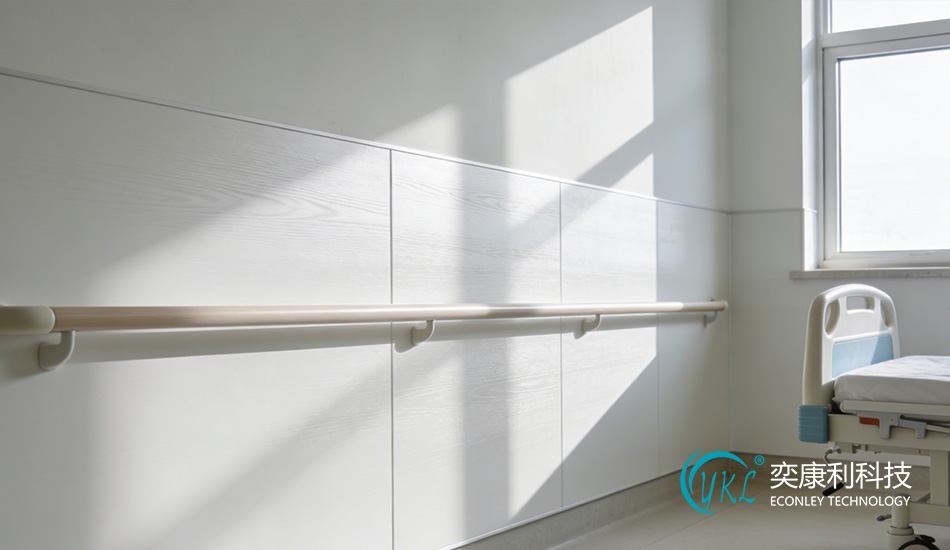
Different functional zones in hospitals have distinct requirements for wall panels, and Hospital Wall Panel Installation Effect Diagram tailored to specific scenes can better play a guiding role. For high-sterility areas such as operating rooms and ICUs, the installation effect diagram focuses on showing the seamless splicing effect of wall panels, the coordination with sterile equipment, and the overall clean and bright visual effect—helping the construction team grasp the key points of sterile environment construction.
For general wards and pediatric areas, the diagram emphasizes the warm and reassuring effect brought by the color and texture of wall panels, as well as the matching effect with ward facilities such as beds and handrails. This ensures that the installed space can meet the psychological comfort needs of patients while ensuring functionality. For wet areas such as bathrooms and laundry rooms, the installation effect diagram clearly shows the waterproof joint treatment of wall panels and the coordination with moisture-proof facilities, providing a clear reference for the construction of moisture-proof and anti-mold environments. These scene-specific diagrams make the installation requirements more precise and targeted.
In the construction implementation stage, Hospital Wall Panel Installation Effect Diagram is an important guiding document for the construction team. Traditional construction drawings are often professional and abstract, making it easy for construction personnel to have deviations in understanding during the construction process, leading to inconsistent installation effects with the design requirements. The installation effect diagram, with its intuitive visual expression, clearly shows the installation position, splicing method, and coordination relationship with surrounding facilities of the wall panels.
Construction personnel can directly refer to the diagram to carry out operations such as cutting, splicing, and fixing of wall panels, ensuring that each construction link meets the design standards. For example, the diagram can clearly indicate the connection position between wall panels and hospital handrails, the height of wall panel installation in different zones, and the treatment method of corner joints. This not only improves the construction efficiency but also reduces the rework rate caused by incorrect construction, ensuring the smooth progress of the project and the realization of the expected installation effect.
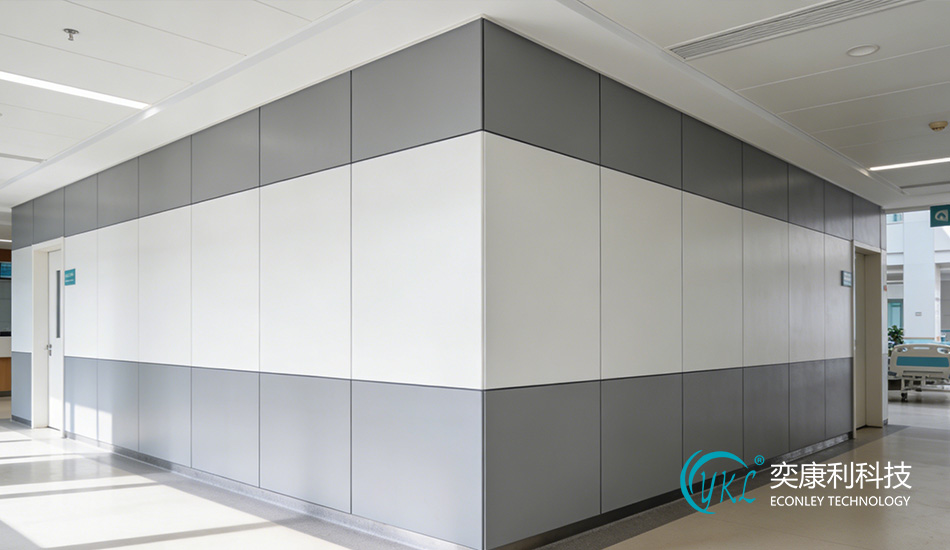
To ensure that the final installation effect is consistent with the diagram, hospital procurement teams need to pay attention to the matching of wall panel selection with the installation effect diagram. Firstly, when selecting wall panels, they should confirm with the supplier that the product’s color, texture, and specifications are completely consistent with those shown in the installation effect diagram—avoiding deviations caused by product differences.
Secondly, it is necessary to combine the actual environment of the hospital to verify the rationality of the installation effect diagram. For example, for hospitals with special lighting conditions, it is necessary to consider whether the color of the wall panels in the diagram can be displayed normally under the actual lighting. In addition, it is necessary to communicate with the construction team in advance to ensure that the construction technology can achieve the effect shown in the diagram. Only by doing a good job in these matching works can the installation effect diagram truly play its guiding role and ensure the success of the wall panel renovation project.
Hospital Wall Panel Installation Effect Diagram also plays an important role in showing the synergistic effect of wall panels with other healthcare supporting products. In the renovation of medical spaces, wall panels need to be coordinated with hospital handrails, curtain tracks, curtains, and other products to form a unified and functional space. The installation effect diagram can intuitively show the matching effect of these products, such as the connection between wall panels and handrails, the embedding effect of curtain tracks and wall panels, and the overall coordination of the space.
This visual display helps hospital procurement teams consider the overall supporting scheme of the space in the early stage, avoiding the problem of inconsistent styles or incompatible installation between different products. Our professional team will customize the integrated Hospital Wall Panel Installation Effect Diagram according to the hospital’s actual needs, showing the synergistic effect of wall panels with our full range of supporting products, providing a comprehensive visual reference for the hospital’s one-stop procurement and construction.
When carrying out hospital wall panel renovation projects, Hospital Wall Panel Installation Effect Diagram is an indispensable tool that runs through the entire process of procurement, design, and construction. It not only helps procurement teams make accurate decisions but also ensures the smooth implementation of construction and the realization of the expected effect. If you are a hospital procurement or engineering team looking for high-quality hospital wall panels and professional installation effect guidance, please contact us immediately. We will provide you with personalized Hospital Wall Panel Installation Effect Diagram and matching product solutions, as well as complete technical support and construction guidance, helping you efficiently complete the medical space renovation project and build a safer, more hygienic, and efficient medical environment.
 Tel :13510328459
 Email :493432861@qq.com
 Phone :0755-82154850/25907050
 Add:205-206, 2nd Floor, Building 2, Xiazao Village Industrial Zone, Gaofeng Community, Dalang Street, Longhua District, Shenzhen City

About

Products
Cases
News
Contact
 493432861@qq.com