Service Hotline:13510328459
 205-206, 2nd Floor, Building 2, Xiazao Village Industrial Zone, Gaofeng Community, Dalang Street, Longhua District, Shenzhen City
Service Hotline:13510328459
205-206, 2nd Floor, Building 2, Xiazao Village Industrial Zone, Gaofeng Community, Dalang Street, Longhua District, Shenzhen City



Time:2025-12-16 Preview:
Hospital corridors are the vital arteries of medical facilities, bearing the continuous flow of patients, medical staff, stretchers, and mobile medical equipment. As a core safety guarantee for these high-demand passageways, Hospital Corridor Handrail is specially designed to adapt to the intensive usage scenarios of corridors, providing stable support, collision protection, and orderly guidance. Its rational deployment directly affects the safety of medical operations and the comfort of users. As a professional supplier of healthcare protection products, we integrate high-quality Hospital Corridor Handrail with our core business lines—including nursing home handrails, hospital curtains/window screens, hospital curtain tracks, antibacterial resin panels, and custom antibacterial boards—to provide targeted medical corridor safety solutions. This article explores the exclusive value, scenario adaptation, and supporting synergy of Hospital Corridor Handrail, offering practical references for hospital procurement and facility renovation teams.
The core value of Hospital Corridor Handrail lies in its targeted response to the unique safety risks of hospital corridors. Unlike handrails in other areas, corridor handrails must simultaneously meet the dual needs of "personnel support" and "equipment collision protection". For patients with limited mobility (such as those using wheelchairs, crutches, or recovering from surgery), the handrail provides a reliable grip point to maintain balance during movement, effectively reducing the risk of falls caused by crowded crowds or unsteady steps.
For busy corridor environments where stretchers and medical trolleys move frequently, Hospital Corridor Handrail with anti-collision structures can buffer the impact force of equipment collisions, protecting the wall structure from damage and avoiding equipment tipping or personnel injuries. Additionally, the continuous layout of corridor handrails can guide the flow of people and equipment, optimizing the operational efficiency of medical passageways and reducing congestion risks.
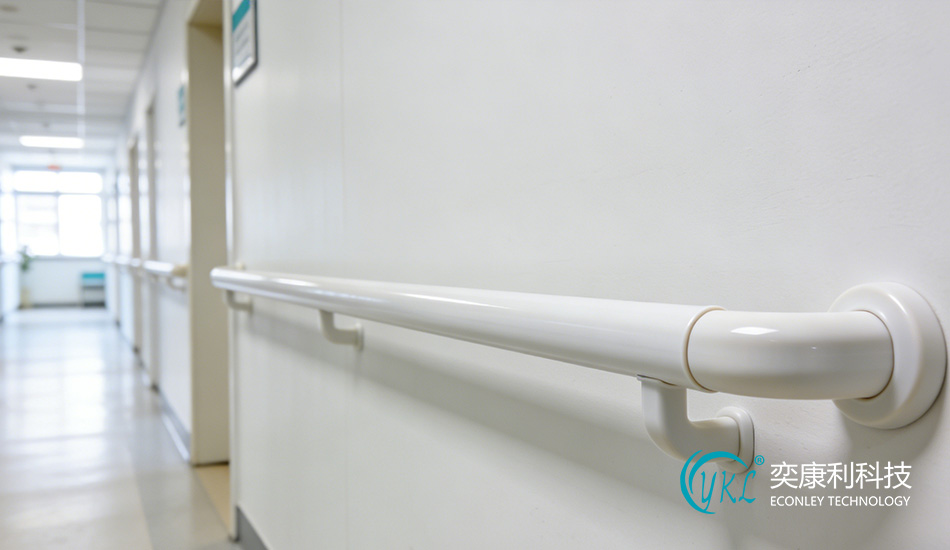
High-quality Hospital Corridor Handrail adopts scenario-adaptive design to cope with the high-intensity usage of medical corridors. In terms of structure, it adopts a continuous installation design without obvious gaps or breaks, ensuring uninterrupted support for users along the entire corridor and smooth transitions at corners and intersections. This design is particularly critical for emergency corridors, where continuous support helps accelerate patient transfer and emergency evacuation.
In terms of surface treatment, the handrail is equipped with anti-slip textures that ensure a firm grip even when hands are wet or covered with medical gloves. The edge of the handrail is polished to be smooth and rounded, avoiding scratches caused by accidental contact with personnel or equipment. For corridors with strong light reflection, some Hospital Corridor Handrail products adopt matte surface design to reduce glare and improve the visual comfort of users.
Hospital Corridor Handrail fully considers the needs of special groups, embodying the humanistic care of medical facilities. For visually impaired patients, tactile warning strips are installed at key positions such as corridor corners, doorways, and stair entrances. These strips remind patients of environmental changes through touch, helping them perceive the passageway layout independently and safely.
For the elderly with limited hand strength and children in pediatric hospital corridors, Hospital Corridor Handrail can be deployed in a double-layer design. The upper layer is suitable for adults and the elderly, while the lower layer is adjusted to a height suitable for children, meeting the use needs of multiple groups simultaneously. For patients with mobility impairments using wheelchairs, the installation height of the handrail is strictly in line with barrier-free design norms, ensuring that they can easily grasp it during movement.
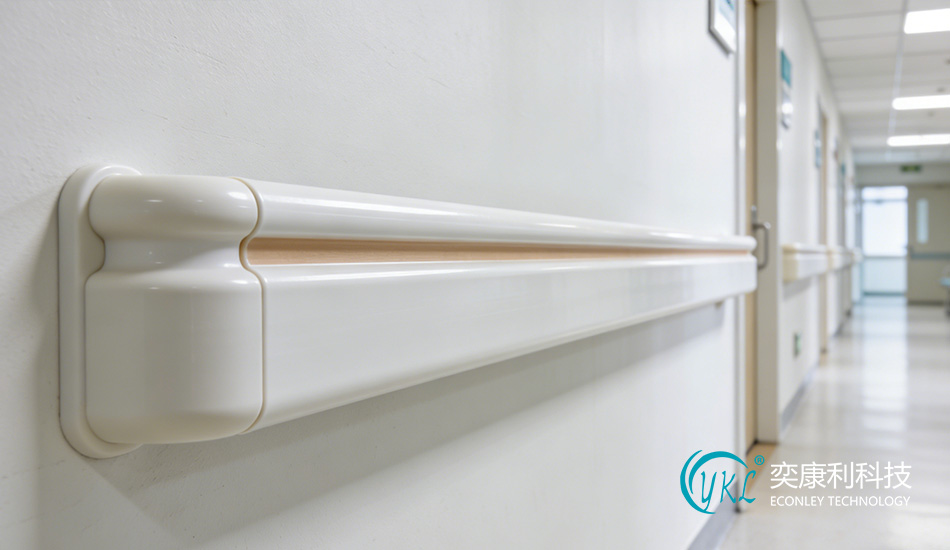
The material selection of Hospital Corridor Handrail is closely related to its safety and durability. High-quality products usually adopt medical-grade composite materials, 304 stainless steel, or PVC materials that meet international medical standards such as ISO 13485. These materials have excellent corrosion resistance and wear resistance, and can withstand frequent disinfection with strong medical agents without material degradation or discoloration.
In terms of safety performance, Hospital Corridor Handrail undergoes strict load-bearing and impact resistance tests before leaving the factory, ensuring that it can maintain stable performance under long-term high-intensity use. The connection between the handrail and the wall adopts a reinforced fixing structure to avoid loosening caused by frequent collision or pulling, providing reliable safety guarantee for users.
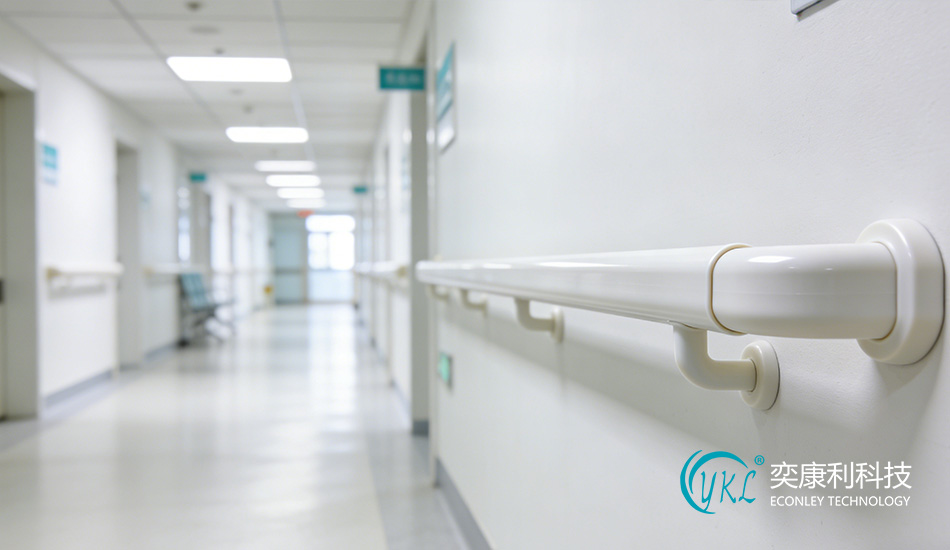
The value of Hospital Corridor Handrail is further amplified through synergistic deployment with other corridor supporting facilities. When installed, it can be perfectly matched with antibacterial resin panels and custom antibacterial boards. The alignment of handrail fixing points with the installation positions of the panels ensures a seamless transition between the wall and the handrail, while the antibacterial properties of both products form a double barrier against bacteria, improving the overall hygiene level of the corridor.
In addition, the installation position of Hospital Corridor Handrail is scientifically coordinated with hospital curtain tracks and curtains. It avoids overlapping or interfering with the curtain sliding range, ensuring the smooth operation of the curtain system while maintaining the safety support function of the handrail. For rehabilitation hospitals and nursing homes, the corridor handrail can be seamlessly connected with nursing home handrails to form a continuous safety support system covering the entire facility.
 Tel :13510328459
 Email :493432861@qq.com
 Phone :0755-82154850/25907050
 Add:205-206, 2nd Floor, Building 2, Xiazao Village Industrial Zone, Gaofeng Community, Dalang Street, Longhua District, Shenzhen City

About

Products
Cases
News
Contact
 493432861@qq.com