Service Hotline:13510328459
 205-206, 2nd Floor, Building 2, Xiazao Village Industrial Zone, Gaofeng Community, Dalang Street, Longhua District, Shenzhen City
Service Hotline:13510328459
205-206, 2nd Floor, Building 2, Xiazao Village Industrial Zone, Gaofeng Community, Dalang Street, Longhua District, Shenzhen City



Time:2025-12-16 Preview:
Hospital Handrail is an indispensable safety infrastructure in medical environments, serving as a reliable support for patients, the elderly, and medical staff in corridors, bathrooms, rehabilitation areas, and other key zones. Its rational configuration and quality performance directly affect the safety of medical operations and the comfort of users. As a professional supplier of healthcare protection products, we integrate high-quality Hospital Handrail with our core business lines—including nursing home handrails, hospital curtains/window screens, hospital curtain tracks, antibacterial resin panels, and custom antibacterial boards—to provide comprehensive medical environment safety solutions. This article explores the core safety value, scenario adaptation, selection criteria, and supporting synergy of Hospital Handrail, offering practical references for hospital procurement teams.
The core value of Hospital Handrail lies in its multi-dimensional safety protection capabilities tailored to medical scenarios. Firstly, it provides stable fall prevention support. For patients with limited mobility, the elderly recovering from surgery, and disabled individuals, the handrail offers a reliable grip point to maintain balance during walking, effectively reducing the risk of falls caused by unsteady steps or sudden dizziness. The surface of high-quality Hospital Handrail is treated with anti-slip textures, ensuring a firm hold even when hands are wet or covered with medical gloves.
Secondly, it has excellent collision buffering performance. In busy areas such as hospital corridors where stretchers, medical trolleys, and wheelchairs move frequently, Hospital Handrail with shock-absorbing structures can buffer the impact force of collisions, protecting both the wall structure and the equipment, and avoiding injuries to nearby personnel. Additionally, medical-grade Hospital Handrail is equipped with antibacterial properties, which can inhibit the growth of pathogenic bacteria on the surface, adapting to the strict infection control requirements of medical facilities and reducing cross-infection risks.
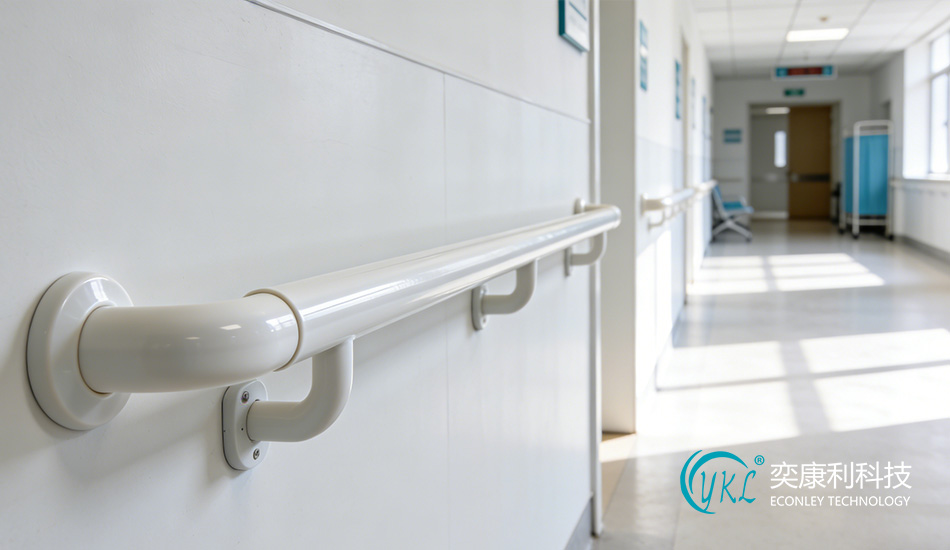
Hospital Handrail exhibits strong adaptability to different functional areas of medical facilities, realizing targeted safety protection. In general hospital corridors, continuous-installed Hospital Handrail is the preferred choice. It extends along the entire corridor with smooth transitions at corners, providing uninterrupted support for users and optimizing the flow of people in high-traffic areas. The installation height is designed in line with ergonomic principles, adapting to the use needs of most adults and the elderly.
In hospital bathrooms and toilets—high-risk areas for falls—Hospital Handrail is usually designed in L-shaped or U-shaped structures, installed beside toilets, sinks, and bathtubs to support users during sitting, standing, and washing. These handrails have enhanced load-bearing capacity to withstand repeated use and weight-bearing. In rehabilitation areas, Hospital Handrail can be customized into adjustable-height or multi-layer designs, matching the rehabilitation training needs of patients with different mobility levels. In pediatric wards, child-friendly Hospital Handrail with rounded edges and non-toxic materials is used to ensure the safety of young patients.
For hospital procurement teams, scientific selection of Hospital Handrail is crucial to ensuring product quality and scenario adaptability. Firstly, prioritize safety and compliance: select products that meet international medical standards such as ISO 13485 and national medical facility norms, and verify relevant certification documents such as material safety reports and antibacterial performance test reports.
Secondly, focus on scenario adaptability: select the appropriate handrail type (continuous, adjustable, anti-collision) according to the functional characteristics of the area. For example, choose anti-collision handrails for corridors with frequent equipment movement, and anti-slip and waterproof handrails for humid areas such as bathrooms. Thirdly, consider usability and durability: the handrail should have a comfortable grip, smooth surface without sharp edges, and be made of wear-resistant and corrosion-resistant materials to ensure long-term stable performance under high-intensity use.
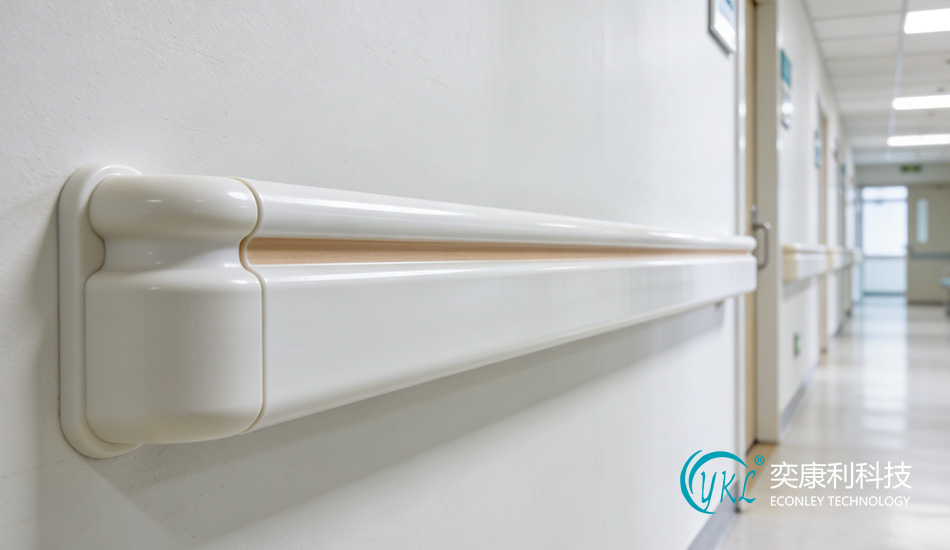
The safety and practical value of Hospital Handrail can be further amplified through synergistic integration with other healthcare supporting products. When installed in hospital corridors, Hospital Handrail can be perfectly matched with antibacterial resin panels and custom antibacterial boards. The alignment of handrail fixing points with the installation positions of the panels ensures a seamless transition between walls and handrails, while the antibacterial properties of both products form a double barrier against bacteria, improving the overall hygiene level of the environment.
In addition, the installation position of Hospital Handrail is scientifically coordinated with hospital curtain tracks and curtains to avoid mutual interference, ensuring the smooth operation of the curtain system while maintaining the safety support function of the handrail. For nursing homes and rehabilitation hospitals, Hospital Handrail can be seamlessly connected with nursing home handrails to form a continuous safety support system covering corridors, bedrooms, and rehabilitation areas. This one-stop synergistic configuration simplifies the procurement and installation process, ensures product compatibility, and enhances the overall safety and coordination of medical facilities.
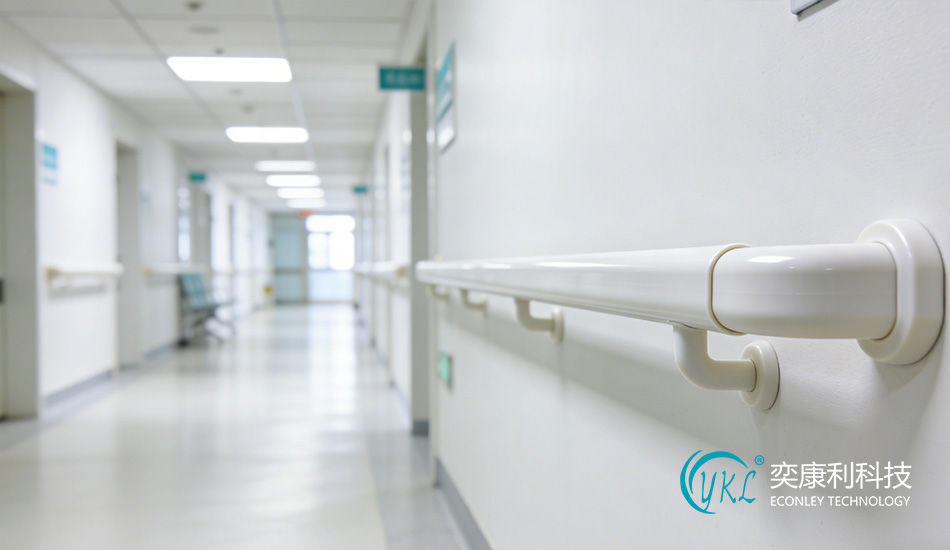
Proper maintenance is essential to ensure the long-term safety and performance of Hospital Handrail. Regular inspection is the core of maintenance work: regularly check whether the handrail fixing parts are loose, especially in high-traffic areas, and tighten them in a timely manner if any looseness is found. For the surface of the handrail, clean and disinfect it regularly with medical-grade disinfectants to maintain its antibacterial performance and avoid bacteria accumulation.
If the handrail surface is scratched or damaged, repair or replace the affected parts in time to prevent further deterioration of performance. It should be noted that the maintenance process should comply with medical facility management norms, and maintenance records should be kept in detail to provide a basis for subsequent safety inspections. The simple maintenance characteristics of high-quality Hospital Handrail reduce the long-term operation and maintenance costs of medical facilities.
 Tel :13510328459
 Email :493432861@qq.com
 Phone :0755-82154850/25907050
 Add:205-206, 2nd Floor, Building 2, Xiazao Village Industrial Zone, Gaofeng Community, Dalang Street, Longhua District, Shenzhen City

About

Products
Cases
News
Contact
 493432861@qq.com