Service Hotline:13510328459
 205-206, 2nd Floor, Building 2, Xiazao Village Industrial Zone, Gaofeng Community, Dalang Street, Longhua District, Shenzhen City
Service Hotline:13510328459
205-206, 2nd Floor, Building 2, Xiazao Village Industrial Zone, Gaofeng Community, Dalang Street, Longhua District, Shenzhen City



Time:2025-12-16 Preview:
Hospital handrails serve as critical safety barriers for patients, medical staff, and visitors, and adhering to rigorous Hospital Handrail Installation Standards is essential to ensuring their protective function, compliance with regulations, and long-term reliability. Improper installation that deviates from standard requirements can lead to safety hazards such as handrail loosening, inadequate support, or conflicts with other medical facilities, directly affecting the operational safety of medical environments. As a professional supplier of healthcare protection products, we integrate Hospital Handrail Installation Standards into our one-stop solutions, which cover hospital handrails, nursing home handrails, hospital curtains/window screens, hospital curtain tracks, antibacterial resin panels, and custom antibacterial boards. This article systematically explores the core connotations, implementation key points, and compliance value of Hospital Handrail Installation Standards, providing practical guidance for hospital procurement and construction teams.
The fundamental value of Hospital Handrail Installation Standards lies in safeguarding the safety of vulnerable groups in medical scenarios and ensuring compliance with industry regulations. Hospitals accommodate a large number of patients with limited mobility, the elderly, and disabled individuals who rely heavily on handrails for support during movement. Standards-based installation ensures that handrails have sufficient load-bearing capacity and stability, effectively preventing falls and injuries caused by structural instability. Additionally, compliance with installation standards is a prerequisite for hospitals to pass operational inspections, as regulatory authorities such as health commissions and construction supervision departments strictly verify whether handrail installations meet relevant national and international norms.
Moreover, standardized installation enhances the overall operational efficiency of medical facilities. Reasonably installed handrails that comply with ergonomic requirements can reduce the difficulty of patient transfer, alleviate the workload of medical staff, and optimize the flow of people in corridors and functional areas. It also ensures the durability of handrail systems, reducing maintenance costs and replacement frequency caused by improper installation, thereby achieving long-term cost-effectiveness for hospitals.
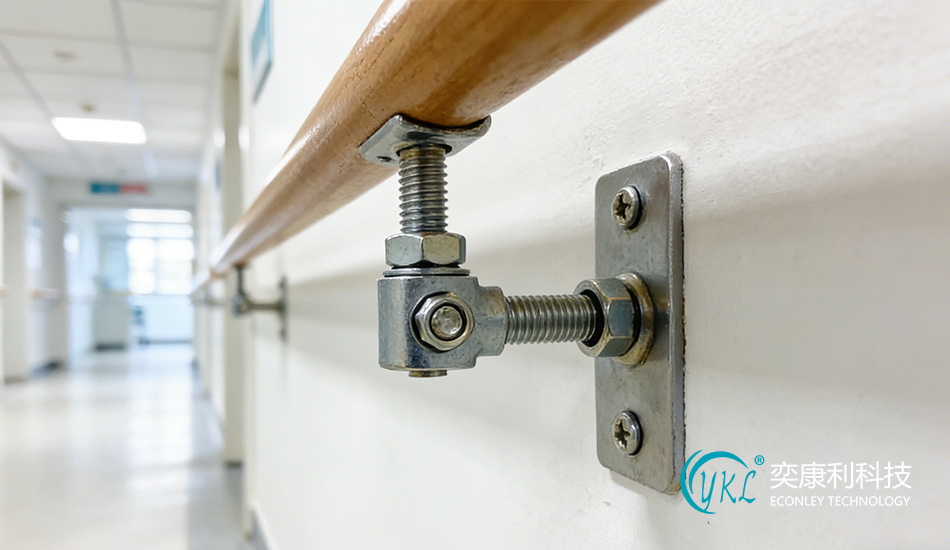
Hospital Handrail Installation Standards are based on a combination of international and national authoritative norms, providing clear guidelines for installation practices. Internationally, standards such as ISO 14122-3 specify general requirements for the installation of handrails in medical and public buildings, emphasizing factors such as structural stability, ergonomic adaptability, and safety protection for special groups. Domestically, relevant norms including the "General Code for Accessibility in Construction and Municipal Engineering" (GB 55019-2021) and "Code for Design of General Hospitals" (GB 51039-2014) detail specific requirements for handrail installation in medical scenarios, covering aspects such as installation height, continuity, and connection methods.
These standard systems collectively define the basic principles of hospital handrail installation: prioritizing safety and accessibility, adapting to the diverse needs of users, and ensuring compatibility with the overall medical environment. Professional installation teams must familiarize themselves with and strictly implement these standards, combining on-site actual conditions to formulate scientific installation plans, avoiding one-size-fits-all operations that may lead to non-compliance.
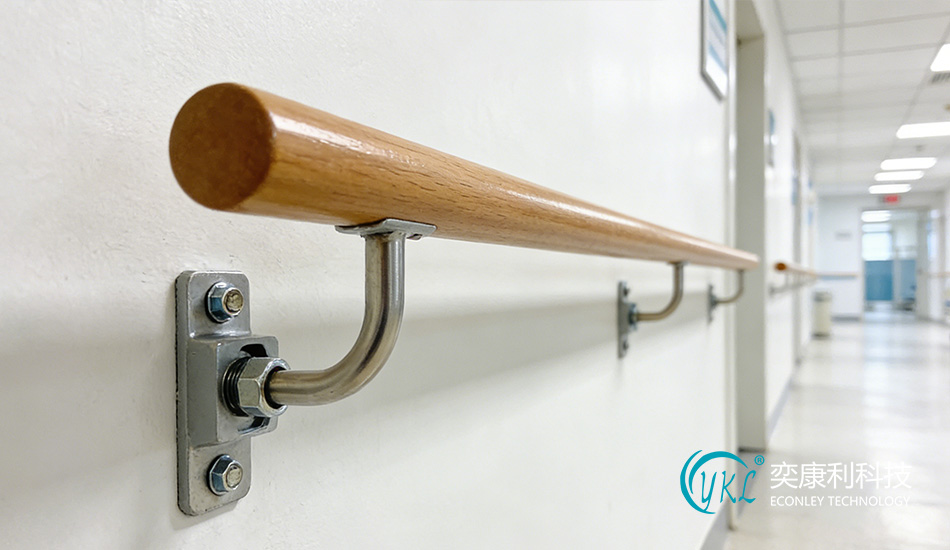
Hospital Handrail Installation Standards require targeted implementation based on different functional areas to ensure practicality and safety. In general hospital corridors, the standards emphasize the continuity of handrail installation—handrails should extend continuously along the corridor, with smooth transitions at corners and no abrupt interruptions, providing uninterrupted support for users. The installation position should avoid conflicts with fire sprinklers, emergency lighting, and other facilities, ensuring unobstructed evacuation routes.
In special areas such as hospital bathrooms and toilets, installation standards focus on anti-slip and load-bearing performance. Handrails should be installed at positions that facilitate patients' sitting and standing movements, with firm fixing methods to withstand repeated use and weight-bearing. In rehabilitation areas and pediatric wards, the standards require adaptive adjustments—for example, installing double-layer handrails to meet the needs of both adults and children, and using smooth edge treatments to prevent scratches. These scenario-specific requirements ensure that handrails fully exert their protective function in different medical environments.
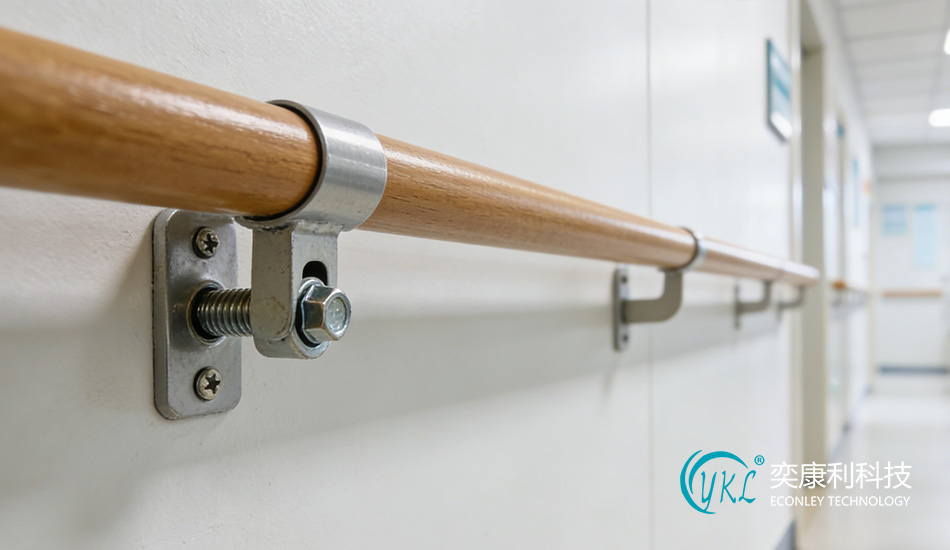
Ensuring the quality of handrail installation in accordance with Hospital Handrail Installation Standards requires adherence to strict quality control principles throughout the process. Firstly, pre-installation preparation must be thorough: conduct on-site surveys to confirm the wall structure and load-bearing capacity, select appropriate fixing materials and installation tools, and verify that handrail products meet matching standards.
Secondly, the installation process must be standardized: strictly follow the standard requirements for positioning and marking, ensure the levelness and verticality of handrails, and use standardized connection methods to avoid loosening. After installation, conduct comprehensive inspections, including load-bearing tests, stability checks, and surface smoothness inspections, to ensure that all indicators meet standard requirements. Any non-compliant issues found during inspections must be promptly rectified to eliminate potential safety hazards.
Complying with Hospital Handrail Installation Standards also requires consideration of synergistic adaptation with other healthcare supporting products, which is a key link in optimizing the overall medical environment. When installing handrails, we need to coordinate with the layout of antibacterial resin panels and custom antibacterial boards—aligning the handrail's fixing points with the installation positions of the panels to ensure a seamless transition between walls and handrails, while avoiding damage to the panels during installation.
Additionally, the installation position and height of handrails must be coordinated with hospital curtain tracks and curtains to ensure that the operation of curtains is not affected, and the overall aesthetic and functional coordination of the space is maintained. For nursing homes and rehabilitation facilities, handrail installation can be seamlessly connected with nursing home handrails in accordance with standards, forming a continuous safety support system. This synergistic installation method not only ensures compliance with standards but also improves the efficiency of facility construction and maintenance.
 Tel :13510328459
 Email :493432861@qq.com
 Phone :0755-82154850/25907050
 Add:205-206, 2nd Floor, Building 2, Xiazao Village Industrial Zone, Gaofeng Community, Dalang Street, Longhua District, Shenzhen City

About

Products
Cases
News
Contact
 493432861@qq.com