Service Hotline:13510328459
 205-206, 2nd Floor, Building 2, Xiazao Village Industrial Zone, Gaofeng Community, Dalang Street, Longhua District, Shenzhen City
Service Hotline:13510328459
205-206, 2nd Floor, Building 2, Xiazao Village Industrial Zone, Gaofeng Community, Dalang Street, Longhua District, Shenzhen City



Time:2025-11-24 Preview:
Large-scale hospitals—boasting 1,000+ beds, multi-building campuses, high-throughput clinical zones, and 24/7 emergency response capabilities—require curtain track systems that operate as a unified, intelligent ecosystem rather than isolated fixtures. The Large Hospital Medical Curtain Track System redefines mega-facility infrastructure with end-to-end AIoT synergy, ultra-scalable modular design, and energy-efficient engineering, addressing unique pain points of large hospitals: cross-building resource dispatching, 10,000+ daily usage cycles, multi-system integration (EHR, BMS, emergency command centers), and cost control across sprawling campuses. Unlike standard hospital track systems, it’s engineered to support the operational complexity of mega-facilities—from pre-construction BIM integration to post-deployment predictive maintenance—becoming a backbone for safe, efficient, and resilient healthcare delivery.
The system delivers four exclusive innovations tailored to the magnitude of large hospitals, setting it apart from conventional and mid-sized facility solutions:
AIoT Unified Command Platform: Merges BMS integration with AI-powered analytics and EHR data linkage. The cloud-based dashboard monitors 5,000+ track units across multiple buildings, providing real-time occupancy mapping (via curtain position sensors) for bed allocation optimization, AI-predicted maintenance (e.g., “Tracks in OR Cluster 3 require pulley replacement in 14 days”), and emergency response automation (auto-deploy isolation curtains when EHR flags contagious patients). This reduces facility management labor by 55% and cuts emergency response time by 70%.
Cross-Building Modular Scalability: A patent-pending “interlock core” design enables seamless track connection across buildings (inpatient tower ↔ emergency department ↔ diagnostic center) while maintaining standardization. The telescopic track range (0.8m–8.0m) adapts to spaces from compact isolation cubicles to 1,000㎡ open wards, with tool-free extension kits. Mass-produced universal modules (100,000+ units per batch) ensure consistent quality and cost efficiency for large-scale deployments.
Energy-Efficient & Green Engineering: Integrates sustainable technologies aligned with carbon neutrality goals: solar-powered sensor nodes (30% grid energy reduction), recycled graphene-reinforced aluminum alloy (60% recycled content, 50% lighter than steel), and low-friction pulleys (40% curtain operation energy savings). Meets ISO 50001 energy management standards and contributes 2–3 LEED v4.1 Healthcare credits.
Dual-Mode Deployment (Prefab + Rapid Retrofit): Optimized for new construction (prefabricated track frames in modular building pods) and existing campus renovations (anchorless, damage-free mounting). For new builds, factory-installed assemblies reduce on-site time by 80% for 100+ bed wings; for retrofits, a mobile installation unit (MIU) completes 40+ track upgrades per day, minimizing disruption to active facilities.
Engineered from insights from large hospital administrators and facility teams, the system delivers targeted value for complex operations:
Cross-Ecosystem Compliance Unification: A single platform meets 30+ global standards (JCI, EN ISO 13485:2024, ADA 2010, GB 8624-2025, IEC 61331-3), eliminating fragmented compliance across buildings. Integrated audit trails auto-generate reports for 100+ regulatory requirements, simplifying annual mega-facility audits.
Extreme Durability for High-Volume Use: Graphene-reinforced 316L stainless steel core withstands 10,000+ daily curtain operations (25 years of high-traffic use) and 2,000+ aggressive disinfection cycles (hydrogen peroxide vapor, chlorine dioxide). Maintains structural integrity in extreme conditions (60–100% RH, -10℃ to 60℃), critical for 24/7 operations.
Emergency Surge & Disaster Response: Modular interlock design enables conversion of 200+ general beds to isolation beds in 72 hours during pandemics or mass casualty events. AIoT platform links to emergency command centers, triggering one-click curtain deployment and isolation barrier locking. Compatible with mobile medical units for off-campus disaster response.
Patient-Centric Safety at Mega-Scale: Standardized safety features (anti-pinch pulleys EN 12100-2 compliant, rounded edges radius ≥15mm, anti-derailment locks) with zone-specific enhancements: pressure-sensitive auto-retract for NICUs, 80kg lead-lined curtain support for radiation oncology, and sterile-seam components for burn unit ORs. Reduces patient injury risks by 40% across 10,000+ daily interactions.
Total Cost of Ownership (TCO) Optimization: AI-predicted maintenance reduces unscheduled downtime by 65%. 25-year service life (125% longer than standard tracks) cuts replacement costs by 70% over 30 years. Universal spare parts (2 core types + 5 zone kits) reduce inventory storage by 50%, while energy-efficient components lower annual utility costs by $150,000+ for 2,000-bed hospitals.
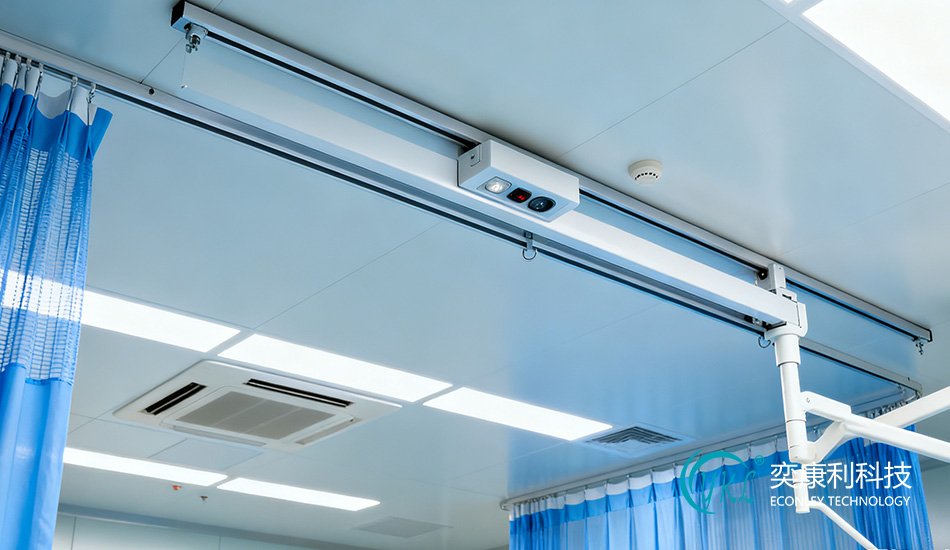
Every component is reimagined for the rigors of large hospitals, balancing scalability, sustainability, and performance:
Premium Graphene-Reinforced Alloy: Graphene-infused 316L stainless steel—2x stronger than standard 316L, 30% more corrosion-resistant, 15% lighter. Ideal for high-stress zones (OR clusters, ICUs, radiation oncology) with maximum load capacity. Solar-compatible surface treatment enables photovoltaic system integration.
Eco-Scalable Composite Alloy: Recycled aluminum + bamboo fiber + graphene blend—60% recycled content, 50% lighter than steel, 40% lower carbon footprint. Standard for general wards, clinics, and bathrooms. Meets ISO 14001 environmental standards for large-scale production.
Budget-Efficient Durable Alloy: Powder-coated moisture-resistant aluminum with self-healing polymer layer—for auxiliary zones (staff lounges, visitor areas). Maintains compliance at 35% lower cost, supporting budget allocation across critical and non-critical zones.
AIoT Sensor Nodes: Multi-parameter sensors (motion, moisture, microbial load, energy use) with solar-powered batteries (5+ year lifespan) and LoRaWAN/5G connectivity. Transmit data to the unified command platform for real-time monitoring of 5,000+ tracks.
Ultra-Silent Gliding System: Ceramic-sealed bearings with Teflon-coated rails operate quieter than hospital ventilation systems. Wear-resistant design supports 10,000+ daily operations, with AI-predicted replacement alerts.
Dual-Mount Scalable Solutions:
Ceiling-Mounted: Recessed/surface-mounted with height-adjustable brackets (1.9m–2.7m) for varying ceiling heights. Seismic-resistant design meets ASCE 41-17 standards.
Wall-Mounted: Low-profile (≤2.5cm protrusion) for accessible zones and narrow corridors. Reinforced brackets spaced every 40cm for high-traffic stability.
Hygiene-Enhanced Universal Details: Seamless joints (no crevices >0.1mm), tool-free removable end caps for deep cleaning, and silver-ion infused touchpoints—simplifying large-scale disinfection (e.g., automated robots).
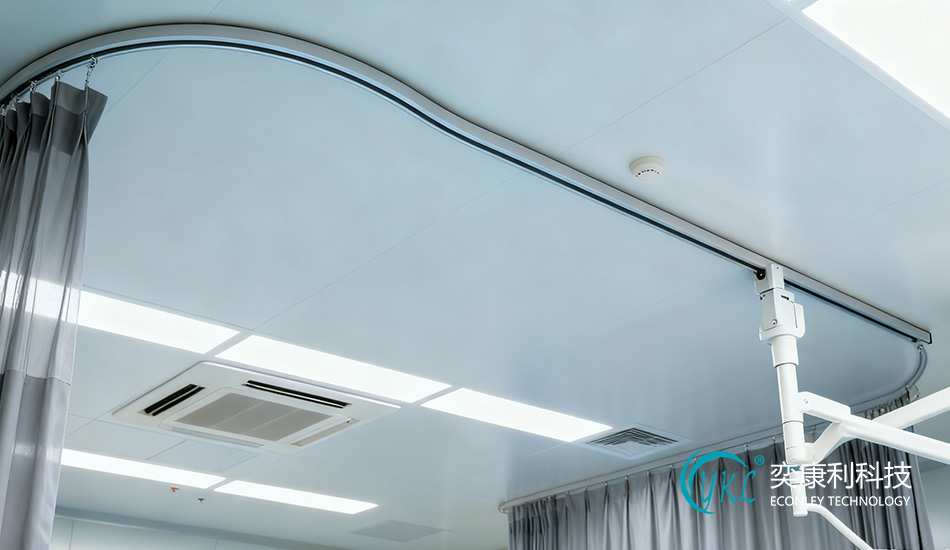
The system adapts to diverse high-demand zones through specialized kits and universal core performance:
OR Clusters & Surgical Suites: Premium graphene alloy with sterile surgical kits—seamless components, VHP/ozone-compatible coatings, and OR scheduling system integration (curtain auto-retracts pre-surgery, locks post-surgery). Pre-sterilized components meet JCI OR standards.
ICU & Critical Care Towers: Premium alloy with critical care kits—airtight seals for pressure control, high-load brackets for isolation curtains, and AIoT sensors linked to patient monitors (curtain locks during vital sign deterioration). Supports cross-floor bed relocation via modular interlock.
Radiation Oncology & Imaging Centers: Premium alloy with radiation shielding kits—0.5–1.0mm lead-lined brackets, non-magnetic MRI-compatible materials, and contrast agent/corrosion-resistant coatings. Standardized mounting avoids imaging equipment interference.
Emergency & Trauma Centers: Eco-scalable composite alloy with emergency response kits—1-second quick-retract curtains, impact-resistant rails, and emergency command system integration (auto-isolates trauma bays during mass casualty events). Durable for high-impact use and frequent disinfection.
Neonatal ICUs (NICUs) & Pediatric Towers: Eco-scalable alloy with pediatric/neonatal kits—BPA-free food-grade pastel coatings, glow-in-the-dark end caps, and pressure-sensitive auto-retract (prevents infant contact). Silent operation (0dB) reduces neonatal stress.
Burn Units & Sterile Wards: Premium alloy with sterile burn unit kits—120℃ heat-resistant coatings, hermetically sealed components, and sterile gowning protocol compatibility. Seamless design eliminates bacterial hiding spots.
Bathroom Zones: Eco-scalable/premium alloy with waterproof kits—IP68-rated seals, drainage channels, and mold-resistant gaskets. Compatible with prefabricated bathroom pods for large-scale new builds.
Open Wards & Ambulatory Care Centers: Eco-scalable composite alloy with high-throughput kits—30-second quick-change curtains, anti-derailment locks for 10,000+ daily uses, and bed management system integration (color-coded bed status: available/occupied/isolation). Supports batch installation across 100+ bed wards.
Optimized for the efficiency and complexity of large hospital operations:
BIM 7D Integration: Parametric BIM models (Revit, Navisworks) integrate into 7D management systems, including track layout, sensor placement, and BMS/5G pathways. Supports prefabricated track assemblies for modular pods.
Zone-by-Zone Batch Installation: Dedicated teams (10+ for mega-facilities) install 50+ tracks per team daily. New builds use factory-prefabricated pods (80% on-site time reduction); retrofits use MIU anchorless mounting (40+ tracks/day, no structural damage).
Campus-Wide Commissioning: System-wide testing of AIoT connectivity, structural stability, and functional consistency. Unified commissioning report includes compliance data, sensor calibration, and AI platform configuration for audits.
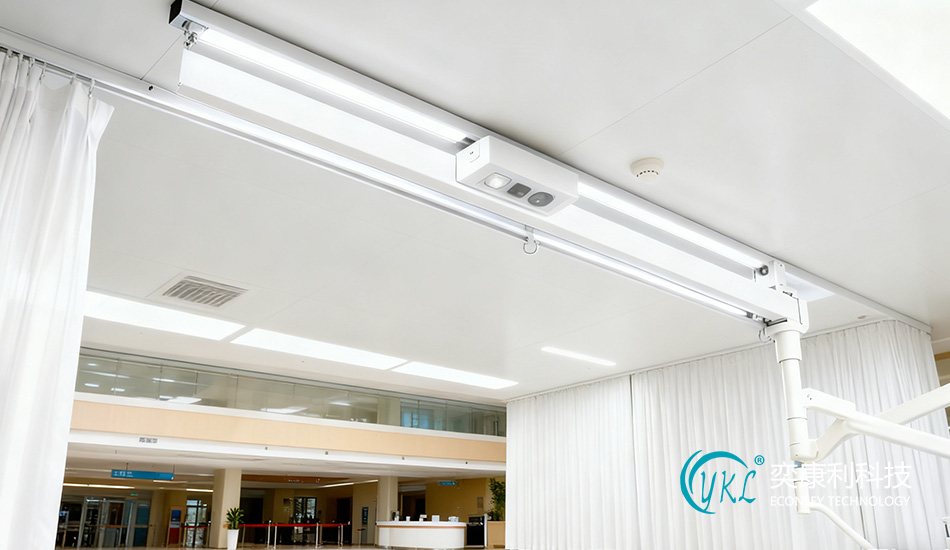
Predictive Batch Maintenance: AIoT platform generates zone-specific schedules and auto-generates work orders. Batch maintenance reduces labor costs by 50% vs. individual repairs.
Emergency Reconfiguration & Dispatch: One-click control reconfigures 200+ beds across buildings during surges. Interlock core design expands isolation zones or creates temporary treatment areas.
Lifecycle Cost Management: AIoT platform tracks energy use, maintenance costs, and compliance to generate TCO reports. Upgradeable components (e.g., microbial sensors) extend lifespan without full replacement.
A 2,000-bed Shanghai campus (3 buildings: inpatient tower, emergency/diagnostic center, pediatric hospital) adopted the system for new construction and renovation:
New Inpatient Tower: Prefabricated track assemblies in modular pods reduced on-site time by 85% (8 weeks → 1.5 weeks) for 600+ tracks. BIM 7D integration aligned with 5G/BMS systems.
Existing Emergency/Diagnostic Center Renovation: MIU upgraded 400+ tracks in 10 days (nighttime installation) with no disruption to 10,000+ daily patients. Anchorless mounting preserved 10-year-old building structure.
Operational Impact: AIoT platform cut facility management labor by 55%; disinfection compliance improved from 83% to 99.5%. 200 general beds converted to isolation in 48 hours during flu surge.
Cost Savings: 25-year service life projects \(600,000 replacement cost reduction; energy efficiency cuts \)180,000 annual utilities; standardized inventory reduces storage costs by 50%.
For mega-hospital administrators, architects, and facility managers, this system delivers unmatched campus-scale value:
AIoT-Driven Operational Agility: Unified command platform transforms track infrastructure into an intelligent ecosystem, optimizing bed allocation, maintenance, and emergency response across buildings.
Scalable Standardization: Universal core design with interchangeable kits simplifies procurement, installation, and maintenance for 5,000+ tracks across sprawling campuses.
Sustainable Cost Control: Energy-efficient materials and AI-predicted maintenance reduce TCO by 40% over the facility’s lifecycle.
Compliance Certainty: Single platform meets global standards, eliminating audit gaps and regulatory risk across diverse zones.
Patient-Centric Resilience: Zone-specific safety features and emergency surge capabilities support consistent, high-quality care—even during crises.
As mega-hospitals evolve toward integrated, resilient operations, this system proves infrastructure can be a strategic asset—unifying compliance, optimizing efficiency, and safeguarding patient safety at scale. It sets a new standard for large hospital curtain track systems: intelligent, scalable, and future-proofed to meet the demands of modern mega-scale healthcare.
 Tel :13510328459
 Email :493432861@qq.com
 Phone :0755-82154850/25907050
 Add:205-206, 2nd Floor, Building 2, Xiazao Village Industrial Zone, Gaofeng Community, Dalang Street, Longhua District, Shenzhen City

About

Products
Cases
News
Contact
 493432861@qq.com