Service Hotline:13510328459
 205-206, 2nd Floor, Building 2, Xiazao Village Industrial Zone, Gaofeng Community, Dalang Street, Longhua District, Shenzhen City
Service Hotline:13510328459
205-206, 2nd Floor, Building 2, Xiazao Village Industrial Zone, Gaofeng Community, Dalang Street, Longhua District, Shenzhen City



Time:2025-11-20 Preview:
In the highly regulated and detail-oriented healthcare industry, off-the-shelf solutions often fail to meet the unique spatial, functional, and compliance requirements of medical facilities. Medical track manufacturers specializing in customization from drawings have emerged as critical partners, translating architectural blueprints, technical schematics, and facility-specific needs into precision-engineered track systems. This tailored approach ensures seamless integration with hospital layouts, supports specialized medical functions (e.g., radiation shielding, infection control), and adheres to global healthcare standards—making it the gold standard for modern healthcare infrastructure projects.
Medical track customization from drawings addresses the inherent complexity of healthcare environments by prioritizing precision and adaptability:
Spatial Alignment: Healthcare facilities feature irregular layouts, sloped ceilings, and built-in equipment that demand track systems tailored to exact dimensions. Manufacturers use 2D/3D drawings to create tracks that fit curved corridors, compact examination rooms, or large open wards—eliminating gaps, overlaps, or installation compromises.
Functional Specialization: Drawings detail critical requirements like load capacity (for lead-lined curtains in radiology), noise reduction (for ICU tracks), or antimicrobial coatings (for isolation units). Manufacturers translate these specs into engineered solutions, ensuring tracks support specialized medical functions without performance gaps.
Compliance Integration: Healthcare projects require adherence to strict standards (e.g., EN ISO 13485, NHS HTM 66). Drawings often include compliance benchmarks, and manufacturers use this data to select materials, design structures, and conduct testing that aligns with regulatory mandates.
Seamless Project Coordination: Drawing-based customization synchronizes track production with overall facility construction timelines. Manufacturers work directly with architects, contractors, and healthcare administrators to validate designs, resolve conflicts, and deliver track systems ready for immediate installation.
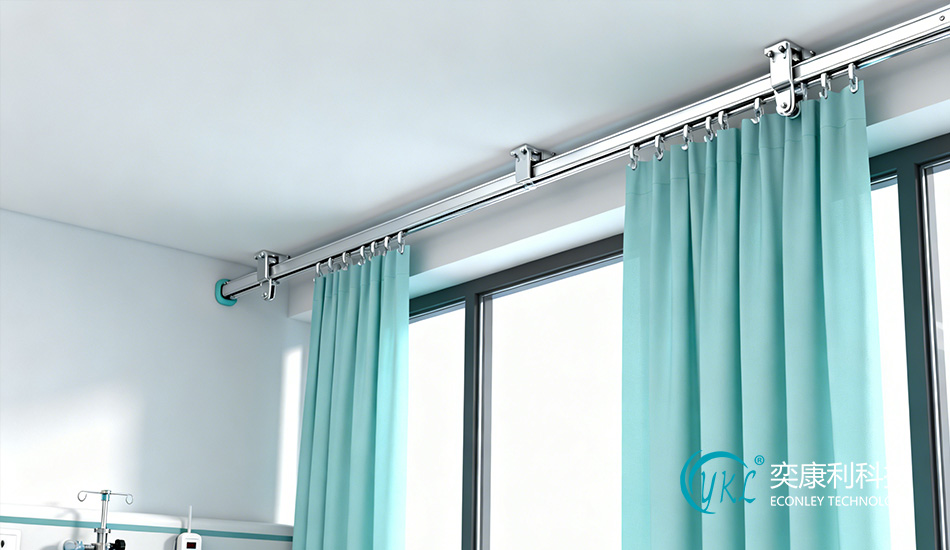
Medical track manufacturers follow a structured, collaborative workflow to bring custom drawings to life—ensuring accuracy and alignment with project goals:
Clients provide detailed technical drawings (CAD files, PDF schematics, or SolidWorks models) outlining track dimensions, mounting points, material preferences, and functional requirements. Manufacturers’ engineering teams conduct a thorough review to:
Verify feasibility of design (e.g., load-bearing capacity, compatibility with ceiling structures).
Identify potential conflicts with other infrastructure (e.g., HVAC ducts, electrical wiring).
Confirm compliance with healthcare standards and local building codes.
Flag opportunities for optimization (e.g., material upgrades for durability or cost savings).
After initial analysis, manufacturers collaborate with clients to refine the design:
3D modeling software generates virtual prototypes, allowing stakeholders to visualize the track system in the facility layout.
For complex projects (e.g., radiation-shielded tracks or motorized systems), physical prototypes are produced to test functionality, fit, and performance.
Adjustments are made to drawings based on feedback, ensuring the final design meets all spatial, functional, and compliance needs.
Drawings specify material requirements (e.g., 304 stainless steel for corrosion resistance, aluminum alloy for lightweight strength), and manufacturers source medical-grade materials that align with:
Load-bearing needs (e.g., reinforced tracks for heavy antimicrobial curtains).
Environmental conditions (e.g., moisture-resistant materials for humid spaces like operating rooms).
Compliance standards (e.g., low-VOC coatings for patient-safe environments).
Specialized functions (e.g., lead-lined substrates for radiology departments, antimicrobial coatings for ICUs).
Using CNC machining, laser cutting, and automated assembly, manufacturers produce tracks to the exact tolerances outlined in the drawings (typically ±0.1mm for critical dimensions). Quality control processes include:
Dimensional inspections to verify alignment with drawings.
Performance testing (e.g., gliding smoothness, load capacity, noise level measurement).
Compliance validation (e.g., antibacterial efficacy testing, fire resistance certification).
Traceability documentation linking each component to the original drawings and material specifications.
Custom tracks are packaged with detailed installation guides aligned with the project drawings. Manufacturers often provide on-site technical support to:
Ensure proper mounting per schematic requirements.
Verify alignment with other facility systems (e.g., curtain attachment points, IoT sensor integration).
Conduct final performance checks (e.g., silent operation, smooth curtain movement).
Manufacturers leverage drawings to deliver highly specialized track systems tailored to diverse healthcare needs:
Shape & Configuration: Drawings enable production of straight, curved, L-shaped, U-shaped, or custom-angled tracks to fit unique room layouts. Joinable segments for long spans or modular designs for reconfigurable spaces are also engineered from schematics.
Load-Bearing Customization: Based on drawing-specified curtain weights (e.g., lead-lined curtains for MRI rooms, heavy antimicrobial curtains for isolation wards), manufacturers adjust track thickness, bracket spacing, and material grade to ensure structural integrity.
Functional Add-Ons: Drawings detail integrated features like motorized mechanisms (for touchless operation), silent pulleys (for low-noise environments), anti-derailment systems, or dust-proof gaskets—all engineered into the track design.
Finish & Aesthetics: Drawings specify color (e.g., neutral tones for clinical settings, brand-aligned hues for specialty clinics) and surface finish (e.g., baked enamel, anodized, powder-coated) to match facility interiors.
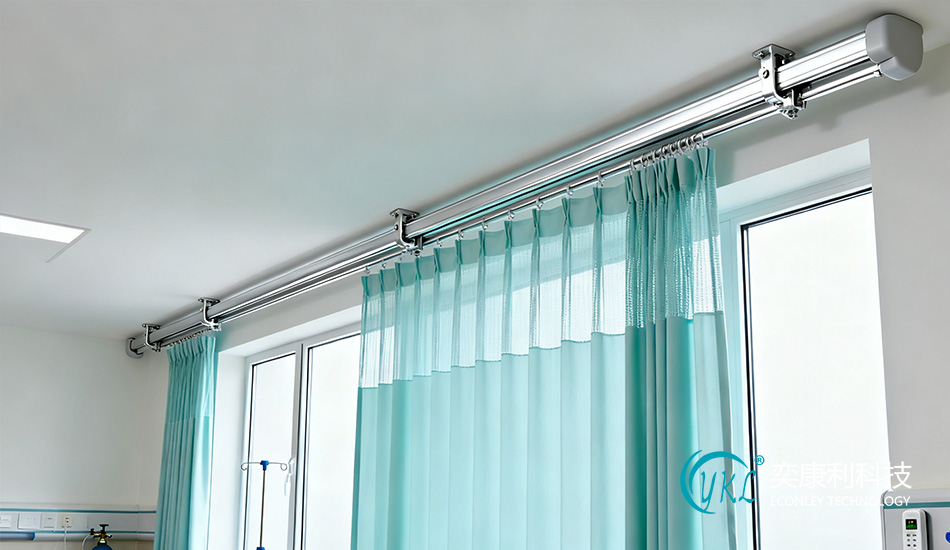
Medical track customization from drawings inherently enhances compliance by:
Linking every design decision to documented requirements (e.g., fire safety standards, antibacterial efficacy benchmarks) outlined in project schematics.
Providing traceability from raw materials to final product, with documentation that maps components to drawing specifications—critical for audits and regulatory inspections.
Ensuring consistency across large-scale projects (e.g., hospital expansions), where multiple tracks must adhere to the same design and compliance standards.
Manufacturers also validate custom tracks against global healthcare standards, including:
EN ISO 13485 (medical device quality management)
NHS HTM 66 (UK healthcare hygiene standards)
GB 8624-2012 (Chinese fire safety standards for medical facilities)
FDA Class II certification (for U.S. healthcare applications)
Antibacterial efficacy standards (e.g., ISO 22196 for surface antimicrobial activity)
Custom medical tracks from drawings are transformative across diverse healthcare settings:
Operating Rooms: Drawings specify hermetically sealed tracks with dust-proof gaskets and silent pulleys, supporting sterile environments and reducing patient disturbance. Tracks are engineered to fit around surgical lights, equipment mounts, and ceiling ducts.
Radiology/MRI Departments: Schematics detail lead-lined tracks (custom thickness per radiation shielding requirements) and corrosion-resistant materials to withstand frequent disinfection. Curved tracks fit around imaging equipment, maximizing usable space.
Pediatric Wards: Drawings include rounded-edge tracks (for safety) and pastel finishes (to reduce anxiety), with custom lengths to fit small patient rooms or play areas. Silent pulleys ensure a calm environment for young patients.
Isolation Units: Schematics outline antimicrobial-coated tracks with airtight sealing, supporting infection control protocols. Modular designs (from drawings) allow quick reconfiguration of spaces during outbreaks.
Hospital Expansions: Drawings ensure new tracks match existing infrastructure, maintaining consistency in performance, compliance, and aesthetics across the facility.
For healthcare architects, contractors, and facility managers, drawing-based customization offers unmatched benefits:
Precision Fit: Eliminates installation delays and rework by delivering tracks engineered to exact project specifications.
Functional Alignment: Ensures tracks support specialized medical needs (e.g., radiation shielding, infection control) as outlined in design schematics.
Compliance Confidence: Every component is traceable to drawings and validated against healthcare standards, reducing regulatory risk.
Cost Efficiency: Avoids waste from ill-fitting standard tracks and minimizes maintenance costs through durable, application-specific designs.
Collaborative Expertise: Manufacturers’ engineering teams provide valuable input to optimize drawings for performance, durability, and installability.
As healthcare facilities evolve to meet growing demands for safety, efficiency, and patient-centric care, medical track manufacturers specializing in customization from drawings remain essential partners. By translating technical schematics into precision-engineered solutions, they deliver track systems that don’t just fit spaces—they enhance the functionality, compliance, and safety of healthcare environments worldwide.
For your next healthcare project, trust drawing-based customization to turn your vision into a reality. Partner with a reputable medical track manufacturer to ensure your track systems are engineered for precision, performance, and peace of mind.
 Tel :13510328459
 Email :493432861@qq.com
 Phone :0755-82154850/25907050
 Add:205-206, 2nd Floor, Building 2, Xiazao Village Industrial Zone, Gaofeng Community, Dalang Street, Longhua District, Shenzhen City

About

Products
Cases
News
Contact
 493432861@qq.com