Service Hotline:13510328459
 205-206, 2nd Floor, Building 2, Xiazao Village Industrial Zone, Gaofeng Community, Dalang Street, Longhua District, Shenzhen City
Service Hotline:13510328459
205-206, 2nd Floor, Building 2, Xiazao Village Industrial Zone, Gaofeng Community, Dalang Street, Longhua District, Shenzhen City



Time:2026-02-24 Preview:
In the complex ecosystem of a healthcare facility, the choice of interior infrastructure directly impacts patient safety, infection control, and operational costs. Hospital divider curtains are a critical component of this infrastructure. Far more than simple room separators, these medical textiles act as a frontline defense against cross-contamination while ensuring patient dignity.
For B2B procurement managers, hospital contractors, and international distributors, sourcing high-quality hospital room partition curtains requires a deep understanding of textile science and regulatory compliance. At Econley, we specialize in engineering medical fabrics that balance extreme durability with clinical performance. This guide explores the essential factors in selecting, maintaining, and installing professional-grade curtain hospital systems.
The primary function of hospital divider curtains is to create a flexible, private environment within shared wards. However, because these curtains are high-touch surfaces, they must be engineered to prevent the harboring of pathogens.
Standard fabrics can host bacteria for weeks. High-performance antimicrobial hospital curtains are treated with silver-ion or zinc-based technologies that actively disrupt the cellular membranes of bacteria. This is essential for preventing the spread of Healthcare-Associated Infections (HAIs) such as MRSA and VRE.
The debate between disposable hospital curtains and traditional launderable fabrics usually centers on turnover speed and risk levels.
Disposable Options: Made from 100% recyclable non-woven polypropylene, these are ideal for high-risk zones like Emergency Rooms (ER) or Burn Units. They eliminate the need for industrial laundering.
Launderable Fabrics: Often made from high-density polyester, these are cost-effective for long-term wards where the "Total Cost of Ownership" is the primary concern.
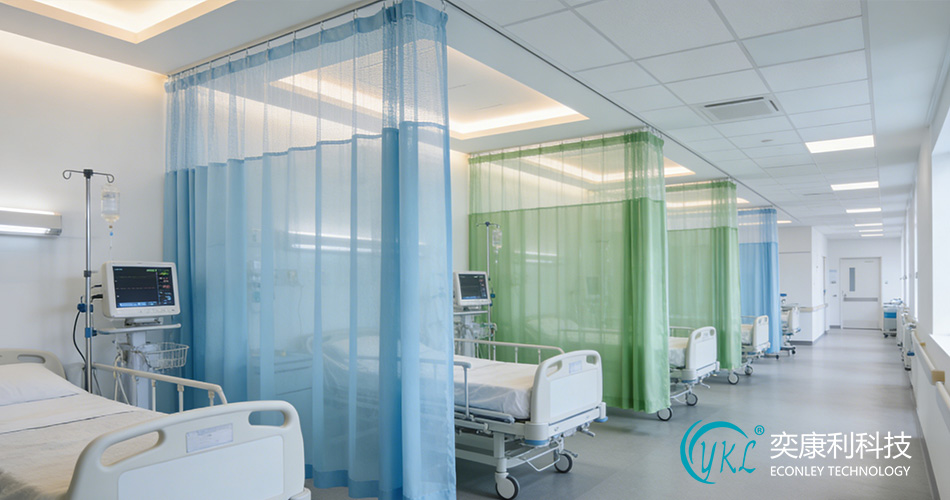
Understanding the composition of a curtain hospital room ensures that the product will pass fire inspections and withstand chemical cleaning.
In environments like shower rooms or trauma bays, a pvc hospital curtain is often preferred. PVC (Polyvinyl Chloride) is inherently waterproof and can be wiped down with heavy-duty disinfectants. For general wards, polyester blends treated with fire-retardant (FR) chemicals are the industry standard.
A common technical requirement for hospital room partition curtains is the mesh top (usually the top 20 inches).
Fire Sprinkler Penetration: In the event of a fire, the mesh allows water from ceiling sprinklers to reach the patient area.
Airflow and Lighting: The mesh ensures that the HVAC system can circulate air effectively and that ambient light reaches the enclosed cubicle.
A medical fabric is only as functional as the hardware that supports it. A sagging or jammed hospital curtain track can delay medical response times and frustrate staff.
Professional hospital curtain tracks should be made from extruded 6063-T5 aluminum. This alloy offers the perfect strength-to-weight ratio.
Silent Rollers: Nylon-wheeled carriers ensure that the curtain glides silently, which is crucial for patient rest.
Track Configurations: Whether you need "L-shaped," "U-shaped," or "Straight" layouts, the track must be securely mounted to the structural ceiling or via suspended brackets.
A hospital shower curtain requires specific hardware. Because these are used in wet environments, the hospital shower curtains and their tracks must be corrosion-resistant. Using anodized aluminum prevents rust and ensures a smooth glide for years.
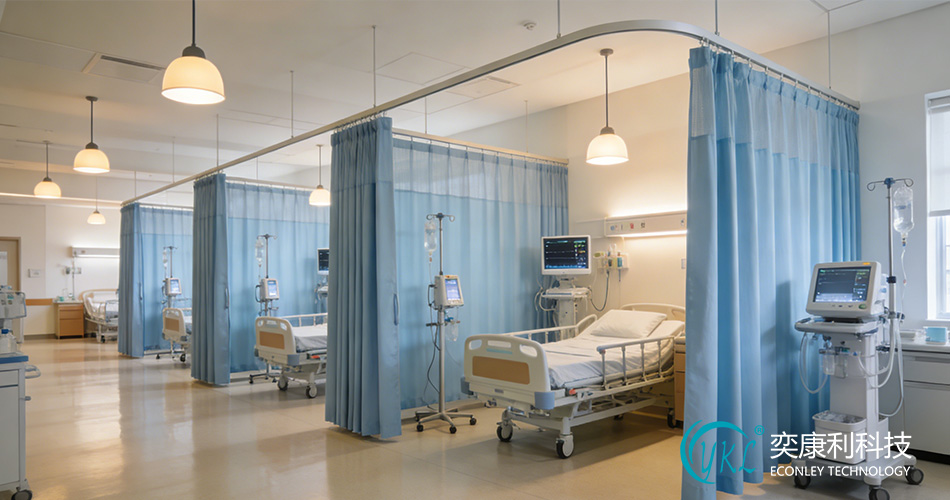
In modern healthcare design, the "sterile and white" look of the past is being replaced by evidence-based design principles. While functionality remains the baseline, the psychology of color is now recognized as a vital tool in patient recovery and stress reduction. Strategic selection of hospital divider curtains can transform a cold, clinical space into a "Healing Environment."
Across the globe, blue hospital curtains remain the industry gold standard for medical interiors. This preference is not accidental; it is rooted in deep-seated psychological associations:
Trust and Professionalism: Blue is universally perceived as a color of stability and authority, helping patients feel secure in the care they are receiving.
Calmness and Physiological Response: Studies in color therapy suggest that soft blue hues can help lower heart rates and reduce anxiety, which is critical in high-stress areas like preoperative bays or cardiac units.
Perception of Cleanliness: Blue suggests a crisp, hygienic environment without the harsh, blinding glare of pure white fabric, which can be visually fatiguing for patients confined to a bed.
While blue is the favorite, Econley understands that different departments have different psychological needs. We offer a wide palette of colors and patterns to help facilities achieve specific design goals:
Soft Greens for Rehabilitation: Green is the color of nature and renewal. Using green hospital room partition curtains in physical therapy or long-term recovery wards can foster a sense of growth and vitality.
Warm Neutrals for Senior Care: Creams, beiges, and soft tans create a "home-like" atmosphere, which is essential in nursing homes to combat the feeling of institutionalization.
Custom Patterns for Pediatrics: Children’s wards often require vibrant, patterned hospital cubicle curtains to distract young patients from the medical equipment and reduce "white coat syndrome."
For private hospitals and healthcare groups, brand identity is crucial. Econley provides customization options that allow facilities to match their hospital divider curtains to their corporate colors. This visual consistency builds brand recognition and reinforces a professional image for visitors and international investors.
By choosing Econley, you are not just buying a medical textile; you are investing in a tailored aesthetic strategy that enhances patient satisfaction and differentiates your facility in a competitive healthcare market.
A critical part of hospital curtain SEO keywords and procurement research involves maintenance schedules.
Industry guidelines generally recommend that hospital divider curtains in high-risk areas be cleaned or changed every 3 to 6 months. However, if a curtain is visibly soiled or the patient had a known infectious disease, it must be changed immediately.
B2B buyers should look for:
Fire Retardancy Certifications: NFPA 701 (USA) or BS 5867 (UK).
GSM (Grams per Square Meter): High-quality hospital room partition curtains usually range from 250gsm to 320gsm.
Colorfastness: The fabric should not fade after multiple high-temperature industrial washes.
In the competitive global market of healthcare construction, choosing a supplier is about more than just finding the lowest price—it is about finding a reliable partner who understands the high stakes of medical compliance and the complexities of international logistics. As a results-driven manufacturer, Econley stands at the intersection of industrial capacity and technical expertise.
We don't just ship products; we integrate into your factory-to-project workflow, ensuring that every hospital divider curtain and corridor handrail arrives on-site ready for inspection and immediate installation. Our value proposition is built on three pillars designed specifically for the needs of B2B contractors and facility developers:
No two medical facilities are identical. From the ceiling heights of a 1970s hospital retrofit to the complex curved tracks of a state-of-the-art trauma center, standard "off-the-shelf" solutions often fail.
Bespoke Sizing: We manufacture hospital cubicle curtains and hospital room partition curtains to your exact height and width specifications, down to the millimeter. This eliminates the risk of curtains "dragging" on the floor (an infection risk) or being too short to provide adequate privacy.
Specialized Layouts: Whether your project requires L-shaped, U-shaped, or continuous circular tracks, our engineering team can produce custom-bent hospital curtain tracks that match your CAD blueprints perfectly.
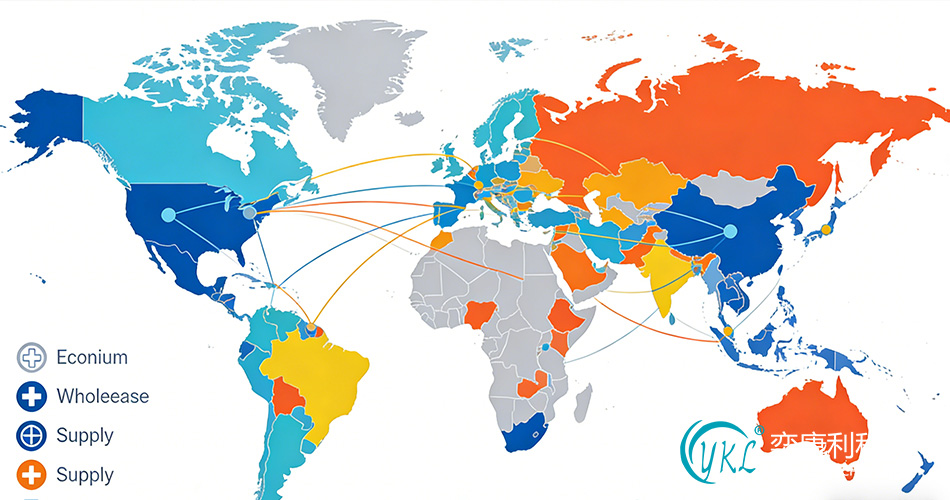
We understand that for large-scale infrastructure projects, the budget is always under scrutiny. By sourcing directly from the Econley factory, you bypass the layers of distributors, wholesalers, and retail markups that typically inflate costs by 30% to 50%.
Direct Wholesale Advantage: Our high-capacity production lines allow us to offer aggressive direct factory wholesale pricing that ensures your project remains within budget without compromising on material quality.
Scalable Production: Whether you are outfitting a 20-bed local clinic or a 1,000-bed national hospital network, our facility is equipped to handle high-volume orders with consistent quality control across every unit.
The most significant hurdle in international healthcare projects is often documentation. A product is useless if it cannot pass a fire marshal's inspection or meet the rigorous criteria of a government tender.
Full Certification Suite: We provide a comprehensive documentation package for every order, including Technical Datasheets (TDS), Material Safety Data Sheets (MSDS), and internationally recognized safety certifications (such as NFPA 701, BS 5867, and ISO 9001).
Tender-Ready Documentation: Our team is experienced in supporting B2B clients through the bidding process. We provide the "proof of quality" required for international tenders, helping you win more contracts by proving that your supply chain meets the highest global standards for antimicrobial hospital curtains and fire-retardant textiles.
Sourcing from China can be daunting due to lead times and shipping complexities. Econley simplifies this through:
Quality Assurance: 100% inspection before packing to ensure zero defects upon arrival.
Export Expertise: We handle the complexities of international shipping, providing robust packaging that ensures your hospital curtain tracks arrive straight and your fabrics arrive clean and ready for hanging.
Disposable hospital curtains should be changed every 3 to 6 months or whenever they become visibly soiled. Launderable curtains should follow a strict schedule mandated by the facility’s infection control committee.
Standard hospital cubicle curtains should be laundered at least twice a year in low-risk areas. In high-traffic zones, a quarterly cleaning schedule is recommended.
Check for the "Inherently Flame Retardant" (IFR) label. IFR means the fire safety is built into the fiber and won't wash out. Additionally, check for anti-microbial test reports (AATCC 100 or ISO 20743).
Installation involves securing aluminum tracks to the ceiling using heavy-duty toggle bolts or brackets. For drop ceilings, "internal bridge" supports are used to connect the track to the building's structural frame.
They are primarily made of 100% fire-retardant polyester. For specialized areas, pvc hospital curtain materials or non-woven polypropylene (for disposables) are used.
The mesh is a safety requirement for fire sprinkler penetration and to allow for proper light and ventilation within the patient's cubicle.
Related content
Hospital Curtain Tracks | Aluminum Ceiling Track Systems | Econley
Hospital Curtains: A Guide to Antibacterial & Fire-Retardant Standards
Sourcing Hospital Corridor Handrails: Wholesale Solutions for Medical Projects
Best Hospital Curtain Tracks 2026 | Durable Ceiling Track Systems | Econley
Wholesale Hospital Bathroom Curtains | Waterproof & Fire-Retardant | Econley
Hospital Handrails Manufacturer | ADA Compliant Corridor Safety | Econley
 Tel :13510328459
 Email :493432861@qq.com
 Phone :0755-82154850/25907050
 Add:205-206, 2nd Floor, Building 2, Xiazao Village Industrial Zone, Gaofeng Community, Dalang Street, Longhua District, Shenzhen City

About

Products
Cases
News
Contact
 493432861@qq.com