Service Hotline:13510328459
 205-206, 2nd Floor, Building 2, Xiazao Village Industrial Zone, Gaofeng Community, Dalang Street, Longhua District, Shenzhen City
Service Hotline:13510328459
205-206, 2nd Floor, Building 2, Xiazao Village Industrial Zone, Gaofeng Community, Dalang Street, Longhua District, Shenzhen City



Time:2026-03-26 Preview:
In the high-stakes environment of modern healthcare, fire safety is not just a regulatory requirement—it is a critical component of patient protection. When it comes to selecting hospital divider curtains, facility managers often face a dilemma: choose cost-effective fabrics that may lose their safety properties after washing, or invest in long-term reliability.
At Econley Technology, we specialize in Inherently Flame Retardant (IFR) medical textiles that set a new benchmark for ward safety. Unlike standard curtains that rely on temporary chemical coatings, our IFR hospital room divider curtains integrate flame-retardant molecules directly into the polymer chain. This means the fire-resistant performance is permanent, remaining fully effective even after 50+ industrial laundry cycles. Fully compliant with NFPA 701 and BS 5867 standards, our solutions provide the peace of mind that global healthcare providers demand.
When sourcing a curtain divider for hospital rooms, procurement officers and facility managers will typically encounter two distinct categories of fire protection: "Topically Treated" (FR) and "Inherently Flame Retardant" (IFR). Understanding the fundamental molecular difference between these two is the key to ensuring long-term regulatory compliance and patient safety.
Inherently Flame Retardant (IFR) fabric is not merely a standard textile with a protective layer; it is an advanced material engineered at the polymer level. Unlike surface-treated fabrics—where fire-retardant chemicals are sprayed, coated, or dipped onto the finished cloth—Econley’s IFR curtains integrate flame-retardant molecules directly into the polymer chain during the extrusion process. Because this fire resistance is a fundamental, internal characteristic of the synthetic fiber itself, the safety performance is permanent and structural.
This molecular bonding ensures that the life-saving properties cannot be rubbed off through physical friction, worn out by daily handling, or—most importantly—washed away during the rigorous cleaning cycles required in medical settings. For a hospital bed divider curtain, this translates to a "life-of-product" safety guarantee. While topically treated curtains require periodic re-testing and expensive chemical re-treatment to maintain their fire-rated status, IFR textiles remain non-combustible for the entire duration of their operational life. This not only simplifies your safety audit trail but also provides a level of consistent, reliable protection that topical treatments simply cannot match. In the high-stakes environment of a hospital ward, where fire can spread in seconds, the permanent nature of IFR technology offers the ultimate peace of mind for both staff and patients.
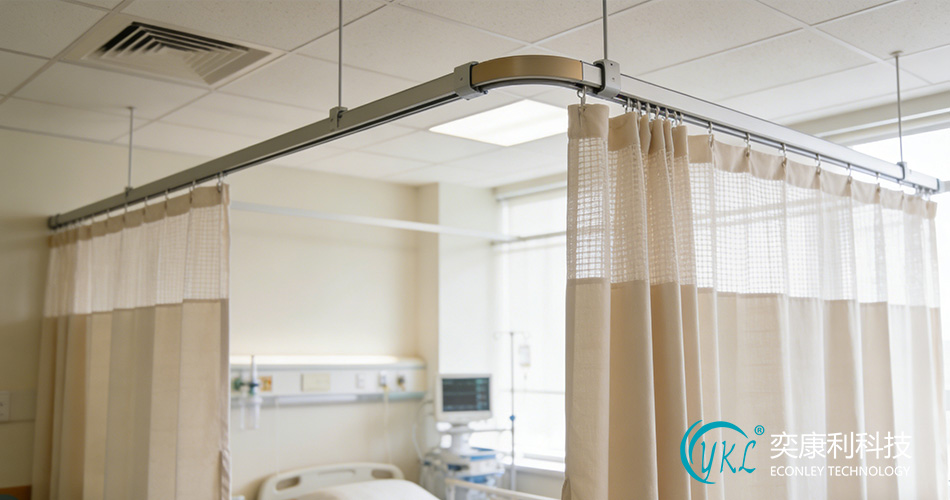
In the United States and most international healthcare jurisdictions, NFPA 701 is the non-negotiable benchmark for the "Methods of Fire Tests for Flame Propagation of Textiles and Films." This standard is established by the National Fire Protection Association to ensure that fabrics used in high-occupancy public spaces do not contribute to the rapid spread of a fire. In a hospital setting, where patients may be bedridden, sedated, or connected to life-support equipment, the speed of fire propagation can mean the difference between a controlled incident and a catastrophe.
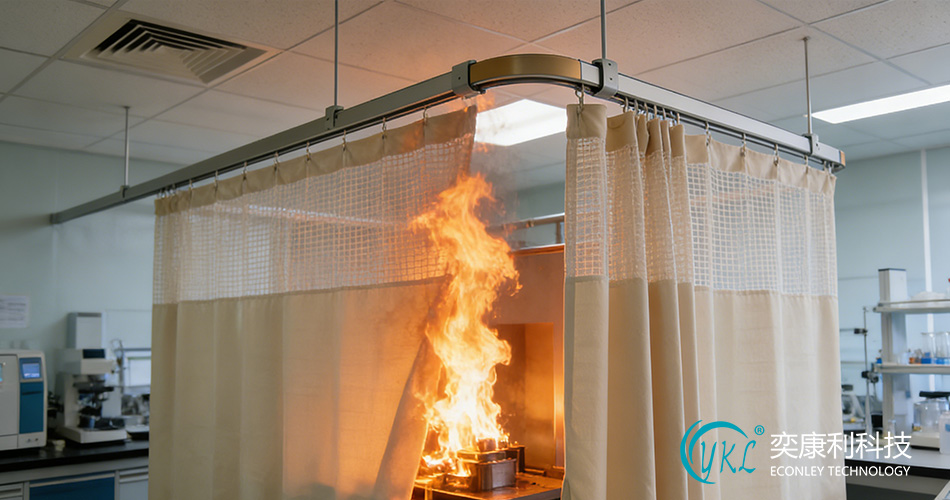
Standard decorative curtains are often highly flammable; they can ignite and spread flames across an entire medical ward in mere seconds. Beyond the fire itself, non-compliant fabrics generate thick, toxic smoke and "flaming drips"—molten bits of fabric that fall and ignite other surfaces, effectively blocking emergency exits and respiratory paths. Hospital divider curtains that carry a certified NFPA 701 tag have undergone rigorous "match-flame" laboratory testing. This certification ensures that the material will self-extinguish within a specific, narrow timeframe once the flame source is removed and, crucially, will not produce the dangerous flaming debris that accelerates a fire's growth.
A major pain point for facility managers is the "wash-out" effect common in topically treated fire retardants. Traditional curtains often lose their protective properties after just a few washes, leaving the hospital unknowingly vulnerable. Our products feature Inherently Flame Retardant (IFR) technology, ensuring they remain fully compliant with NFPA 701 standards even after 50+ industrial laundry cycles. By choosing Econley, you eliminate the logistical nightmare and high cost of periodic chemical re-treatment. This "set-and-forget" safety ensures that your facility passes every fire marshal inspection, year after year, while maintaining the highest level of protection for your patients and staff.
When comparing the hospital curtain divider price, many procurement officers are initially tempted by the lower upfront cost of chemically treated (FR) curtains. At first glance, the budget seems to stretch further with treated fabrics. However, a professional Total Cost of Ownership (TCO) analysis reveals a much different—and more expensive—story for those who choose temporary surface treatments over permanent safety.
Chemically treated fabrics rely on a surface coating that is water-soluble. With every industrial wash cycle, the fire-retardant chemicals gradually leach out of the fabric. This "deterioration via laundering" means that after only a few cleanings, the curtain may no longer meet NFPA 701 standards. To maintain compliance, facilities are forced to pay for periodic laboratory re-testing and expensive on-site chemical re-applications. When you factor in the labor, the cost of specialized fire-retardant sprays, and the administrative burden of tracking "wash counts" for thousands of curtains, the "cheap" option quickly becomes a financial liability.
In contrast, Econley’s Inherently Flame Retardant (IFR) systems are engineered for a 10-year+ operational lifecycle. Because the flame-retardant properties are molecularly fused into the yarn, there is zero performance degradation.
| Feature | Chemically Treated (FR) | Econley IFR Technology |
| Initial Price | Lower | Moderate to High |
| Durability | Deteriorates with washing | Permanent / Lifetime |
| Maintenance | Requires re-treatment audits | Maintenance-free safety |
| Environmental Impact | Chemical runoff during wash | Eco-friendly / Non-toxic |
| Long-term Value | Frequent replacement needed | 5x longer operational life |
While the initial hospital curtain divider price for IFR may be higher, the total absence of re-treatment costs and the significantly lower replacement frequency make Inherently Flame Retardant systems the most financially sound choice. For large-scale commercial healthcare projects, IFR technology typically pays for itself within the first 24 months through savings in maintenance and replacement capital alone. Choosing IFR is not just a safety decision—it is a sophisticated fiscal strategy.
In the high-stakes environment of a modern medical facility, fire safety does not exist in a vacuum. While preventing the spread of a blaze is a legal and ethical imperative, hospital room divider curtains must simultaneously combat a far more frequent and invisible threat: the proliferation of healthcare-associated infections (HAIs). Because privacy curtains are high-touch surfaces—handled hundreds of times daily by patients, nurses, and visiting family members—they can easily become a primary vector for cross-contamination if not properly engineered.
At Econley, we recognize that true patient safety requires a multi-layered defense strategy. Our Inherently Flame Retardant (IFR) fabrics are often integrated with advanced dual-action biosecurity technology to provide a comprehensive shield:
Integrated Antimicrobial Barriers: This specialized treatment inhibits the growth of mold, mildew, and fungi on the fabric surface. In humid hospital environments or areas with fluctuating temperatures, these barriers prevent the biological degradation of the textile, ensuring the curtain remains aesthetically clean and structurally sound for years.
High-Performance Antibacterial Properties: Utilizing cutting-edge silver-ion technology, our fabrics actively reduce the presence of dangerous pathogens on the curtain's surface. These treatments are clinically proven to be effective against a broad spectrum of bacteria, including MRSA, E. coli, and VRE. Because the silver ions are embedded within the finishing process, they provide continuous protection between scheduled launderings, significantly lowering the risk of environmental transmission.
By strategically combining Inherently Flame Retardant fibers with these potent antibacterial finishes, we offer a holistic safety solution. This synergy ensures that your hospital bed divider curtain is not just a passive room divider, but an active medical component that protects patients from both the catastrophic risk of fire and the daily danger of bacterial infection. This dual-protection approach is essential for any facility aiming to achieve the highest standards of clinical hygiene and fire code compliance in 2026.
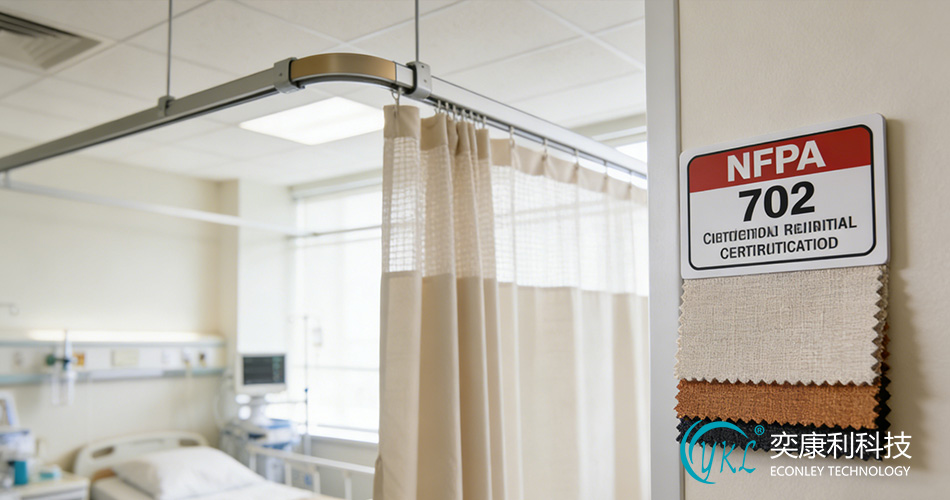
As a leading global manufacturer and supplier, Econley Technology specializes in bridging the critical gap between competitive factory-direct pricing and high-end, project-specific customization. We recognize that for international wholesalers and medical equipment distributors, success in winning restrictive local government tenders or securing private hospital contracts often hinges on the ability to provide highly tailored hardware and textile solutions. A "standard" product rarely satisfies the complex architectural and regulatory demands of a modern healthcare facility.
Choosing a dedicated manufacturing partner allows you to move beyond off-the-shelf limitations and provide a bespoke solution that enhances your market authority. Our OEM solutions are designed to give you a decisive edge:
Precision Custom Sizing & Mesh Engineering: No two hospital wards have identical ceiling heights or fire suppression layouts. We can manufacture hospital divider curtains to any required vertical drop, including precision-engineered 20-inch (or custom-sized) mesh tops. This ensures that every installation allows for 100% sprinkler penetration and optimal HVAC airflow, satisfying even the most stringent fire marshal inspections.
Proprietary Color Matching & Branding: Aesthetics play a significant role in modern "healing environments." We offer professional color-matching services to align your hospital room divider curtains with the specific interior palette or corporate branding of a healthcare network, ensuring a cohesive and premium look across all wards.
Integrated Turnkey Systems: To simplify logistics and reduce on-site labor costs, we provide a completely integrated system. This includes our signature Inherently Flame Retardant (IFR) fabrics paired with high-strength, pre-bent aluminum tracks and near-silent roller hardware, delivered as a single, easy-to-install package.
Whether your client requires a specialized curtain divider for hospital rooms in a VIP clinic or a massive bulk supply of hospital bed divider curtains for a new state-of-the-art medical center, our high-capacity production facility is equipped to handle high-volume orders with world-class quality control and full SGS/NFPA certification traceability.
A: Fire safety regulations for healthcare textiles vary by region, but they all share the common goal of preventing rapid flame spread in clinical environments. The most globally recognized and rigorous standard is NFPA 701 (USA), which specifically addresses the "Methods of Fire Tests for Flame Propagation of Textiles and Films." In the United Kingdom and many Commonwealth nations, BS 5867 Part 2 (Type B or C) is the mandatory benchmark, defining the requirements for curtains, drapes, and window blinds. For the Australian and New Zealand markets, compliance with AS 1530.2 or AS 1530.3 is strictly required to meet local building codes.
At Econley, our Inherently Flame Retardant (IFR) fabrics are precision-engineered to meet or exceed these diverse international benchmarks. By conducting third-party laboratory testing against multiple global standards, we ensure that your procurement project remains fully compliant with local fire marshal inspections, regardless of the facility's geographical location.
A: Absolutely not. This is the primary technological advantage of choosing Inherently Flame Retardant textiles over topically treated alternatives. In standard FR fabrics, fire-retardant chemicals are merely applied as a surface coating, which can be dissolved by detergents or degraded by high-heat drying.
Conversely, Econley’s IFR curtains integrate flame-retardant molecules directly into the polymer chain during the fiber extrusion process. Because the protection is a fundamental part of the fiber's molecular structure, the safety performance is permanent. It cannot be "washed out," rubbed off, or neutralized by chemical cleaners. Our IFR curtains remain 100% effective and compliant even after 50+ industrial laundry cycles at high temperatures, providing a "life-of-product" safety guarantee that ensures long-term patient protection.
A: Transparency and traceability are essential for healthcare procurement. To ensure you are receiving genuine IFR technology, you should always request official certification from an accredited third-party laboratory. We provide full SGS and Intertek laboratory test reports with every shipment of our hospital divider curtains. These comprehensive documents provide empirical proof that the specific batch of fabric has passed the critical "after-flame" (how long the fabric burns after the flame is removed) and "flaming drip" (ensuring no molten material ignites the floor) tests required for NFPA 701 and other international certifications. Never accept a "self-certified" document; always look for the stamp of a globally recognized testing authority.
A: Yes. All our hospital room divider curtains are rigorously tested to meet global safety benchmarks, including NFPA 701 (USA) and BS 5867 (UK). We provide certified test reports to ensure your healthcare facility remains fully compliant with local fire marshal requirements. Our fabrics are also halogen-free and produce low smoke, ensuring a non-toxic environment during emergencies.
 Tel :13510328459
 Email :493432861@qq.com
 Phone :0755-82154850/25907050
 Add:205-206, 2nd Floor, Building 2, Xiazao Village Industrial Zone, Gaofeng Community, Dalang Street, Longhua District, Shenzhen City

About

Products
Cases
News
Contact
 493432861@qq.com