Service Hotline:13510328459
 205-206, 2nd Floor, Building 2, Xiazao Village Industrial Zone, Gaofeng Community, Dalang Street, Longhua District, Shenzhen City
Service Hotline:13510328459
205-206, 2nd Floor, Building 2, Xiazao Village Industrial Zone, Gaofeng Community, Dalang Street, Longhua District, Shenzhen City



Time:2026-03-24 Preview:
In the post-pandemic healthcare landscape of 2026, the demand for high-performance medical textiles has reached an all-time high. Facility managers and procurement officers are no longer just looking for privacy; they are seeking advanced barriers that contribute to a sterile environment. Selecting the best bulk hospital room divider curtains is a strategic decision that impacts patient safety, regulatory compliance, and long-term operational costs.
At Econley Technology, we understand that a hospital curtain is a medical device. This comprehensive guide explores the technical specifications, safety standards, and procurement strategies for modern healthcare facilities.
In the high-stakes environment of 2026 healthcare, a curtain divider for hospital rooms serves as much more than a simple visual screen; it is the first line of def
ense within a multifaceted infection control protocol. The industry has seen a paradigm shift where the traditional "Privacy Curtain" has evolved into a sophisticated "Bio-Barrier," engineered to protect both patients and healthcare providers from cross-contamination.
One of the primary challenges in hospital hygiene is that traditional organic fabrics often act as "fomites"—porous surfaces that can harbor and transfer dangerous pathogens for days. Modern curtain dividers for hospital rooms address this by utilizing cutting-edge antimicrobial silver-ion technology or specialized non-porous recyclable materials. These innovations are designed to actively inhibit the growth of healthcare-associated infections (HAIs), such as MRSA and VRE, effectively breaking the chain of transmission at the bedside.
In crowded emergency departments and high-occupancy multi-bed wards, a well-designed curtain divider for hospital rooms allows for the rapid and flexible reconfiguration of clinical space. This adaptability is crucial during patient surges or emergency triage. Furthermore, the psychological impact of privacy on clinical outcomes cannot be understated. Patients who feel secure in private cubicles report significantly lower stress levels and improved sleep quality, which directly correlates to faster recovery times and higher patient satisfaction scores. By balancing technical "Bio-Barrier" capabilities with the essential need for dignity, these partitions remain an indispensable asset in modern facility management.
In the high-pressure environment of a medical facility, fire prevention is considered just as critical to patient outcomes as rigorous infection control. The reason why NFPA 701 compliance is essential for hospital room divider curtains fundamentally boils down to two non-negotiable factors: strict legal liability and absolute life safety. Hospitals house vulnerable, non-ambulatory patients who cannot quickly evacuate in an emergency; therefore, every material within the patient care zone must act as a barrier to fire, not a fuel source.
NFPA 701, established by the National Fire Protection Association, dictates the standard methods of fire tests for the flame propagation of textiles and films. In the United States, Canada, and increasingly in Middle Eastern and Asian markets, any fabric hanging in a public assembly space—especially a high-occupancy healthcare center—must be certified fire-retardant. Failure to provide documented NFPA 701 certification can result in failed Joint Commission inspections, heavy municipal fines, or the denial of insurance claims following an incident.
When sourcing bulk curtains, it is vital to understand the chemistry of the fabric.
Inherent Flame Retardancy (IFR): This is the gold standard for healthcare. In IFR textiles, the flame-extinguishing properties are engineered into the molecular structure of the polymer fibers themselves. This protection is permanent and superior because the safety features can never be washed out or worn away by friction.
Treated Flame Retardancy: In contrast, some lower-cost fabrics are topically dipped in a chemical fire-retardant solution. While effective initially, this treatment degrades over time, especially when exposed to the harsh detergents and high temperatures required for medical sterilization.
Econley Technical Note: To ensure your facility remains 100% compliant year after year, we exclusively manufacture using IFR materials. This guarantees that your flame retardant standards for partition curtains remain intact even after 100+ industrial laundry cycles, providing a lifetime of safety and peace of mind for hospital administrators.
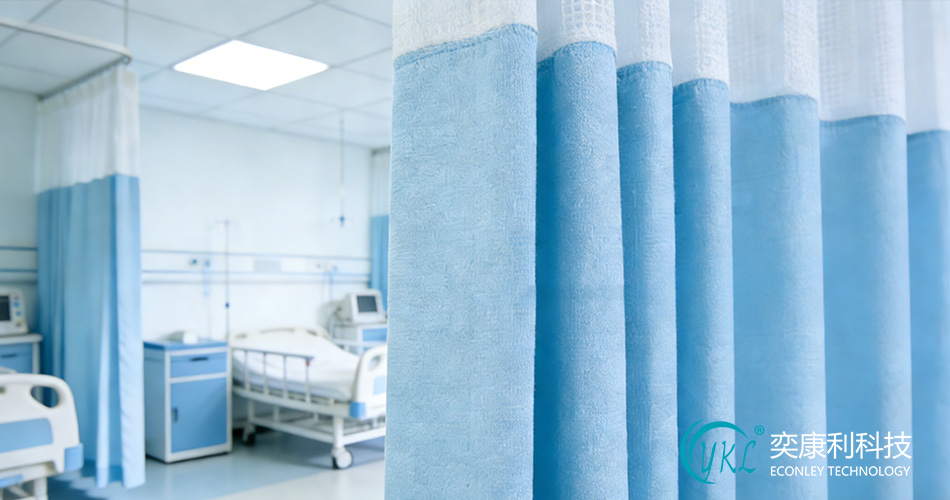
In the digital age, the convenience of one-click purchasing is undeniably attractive. Many small clinics or private practices often search for hospital room divider curtains Amazon due to the immediate availability and the familiar promise of "Prime" shipping. However, for large-scale medical centers, government hospitals, or international distributors, there are significant operational and legal risks hidden behind the convenience of consumer-facing platforms.
When sourcing critical medical textiles from a retail environment, several "Certification Gaps" often emerge. Most products listed on consumer sites lack the verifiable NFPA 701 or BS 5867 documentation required by fire marshals during facility inspections. Furthermore, there is a distinct "Lack of Customization"; standard retail sizes rarely accommodate the complex ceiling heights, radius-bend tracks, or specific cubicle configurations found in professional medical wards. Most importantly, consumer-grade curtains are simply not engineered for "Durability" in a clinical setting. They often fail prematurely when subjected to the high-temperature industrial autoclaves or the harsh chlorine-based disinfectants required to eliminate hospital-acquired infections (HAIs).
Sourcing directly from an established manufacturer like Econley provides a level of technical precision that retail platforms cannot match. Our B2B partnership model allows for:
Integrated Custom Mesh Topping: We customize the top mesh portion (usually 20 inches) to ensure full compliance with fire sprinkler penetration codes, a feature rarely found on pre-made retail curtains.
Specialized Anti-Static Treatments: For ICU and operating environments, we offer fabrics treated to prevent static discharge, which is essential for protecting sensitive electronic diagnostic equipment.
Strategic Wholesale Pricing: By eliminating the middleman, we provide significant volume discounts that far outperform the hospital room divider curtains Amazon retail markup, allowing procurement officers to maximize their annual budgets without compromising on life-safety standards.
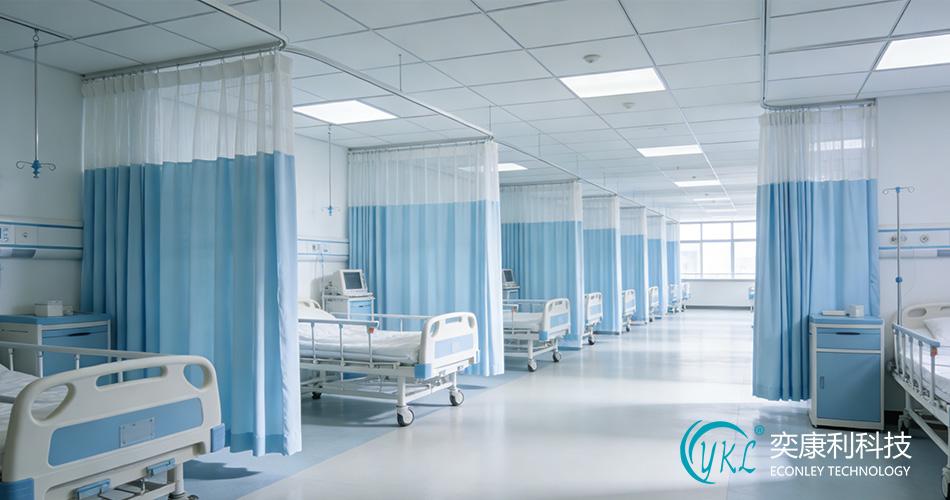
The hospital curtain divider price is influenced by several technical variables. Understanding these can help procurement officers balance their budget without sacrificing quality.
| Material Type | Features | Est. Price (per sq. meter) | Best For |
| Disposable Non-Woven | Recyclable, Anti-bacterial | $3.50 - $5.50 | High-turnover ER/ICU |
| Standard Polyester | Flame Retardant (IFR) | $8.00 - $12.00 | General Wards |
| Premium Antimicrobial | Silver-ion, Stain-resistant | $15.00 - $22.00 | Surgery/Burn Units |
| Disposable Eco-Friendly | 100% Biodegradable | $5.00 - $7.50 | Sustainable Hospitals |
Note: Prices vary based on bulk volume and custom dimensions.
While a disposable curtain may have a lower initial hospital curtain divider price, the recurring cost of replacement must be weighed against the laundering costs of permanent polyester curtains. In 2026, many green-certified hospitals are moving toward high-durability permanent textiles to reduce landfill waste.
To ensure clinical safety and long-term durability, any textile used in a medical environment must adhere to rigorous flame retardant standards for partition curtains. These are not merely suggestions but mandatory legal requirements that vary by jurisdiction. In the United States, for instance, fabrics must pass the NFPA 701 test, which measures the flame propagation of textiles under both small and large-scale ignition sources. In the United Kingdom and much of Europe, the benchmark is BS 5867 Part 2 Type B & C, which tests for both flammability and the fabric's ability to maintain its fire-resistant properties after multiple industrial wash cycles. In the Asian market, the GB 8624-2012 (Grade B1) classification is the standard for flame-retardant building materials.
Beyond fire safety, the operational longevity of a curtain is determined by its physical construction. Econley engineers our medical textiles to meet the following key technical parameters:
Optimal Fabric Weight: We utilize weights ranging from 220gsm to 300gsm. This specific density ensures a premium "drape" that maintains patient privacy while offering the structural integrity needed to withstand the friction of daily use.
Integrated Top Mesh: Our curtains feature a standardized 20-inch (approx. 50cm) mesh header. This is a critical fire code requirement, as it allows ceiling-mounted sprinkler systems to penetrate the cubicle space during an emergency and ensures proper airflow for HVAC systems.
Superior Light Fastness: With a rating of Grade 4.5+, our fabrics are resistant to the "yellowing" or fading effect caused by continuous exposure to harsh hospital UV lighting and overhead fluorescent arrays.
Industrial-Grade Tear Strength: We prioritize high tensile strength and reinforced stitching to withstand the frequent, high-force "tugging" by medical staff and patients in high-traffic emergency wards.
By meeting these global flame retardant standards for partition curtains, facility managers can ensure their infrastructure is both compliant and future-proof.
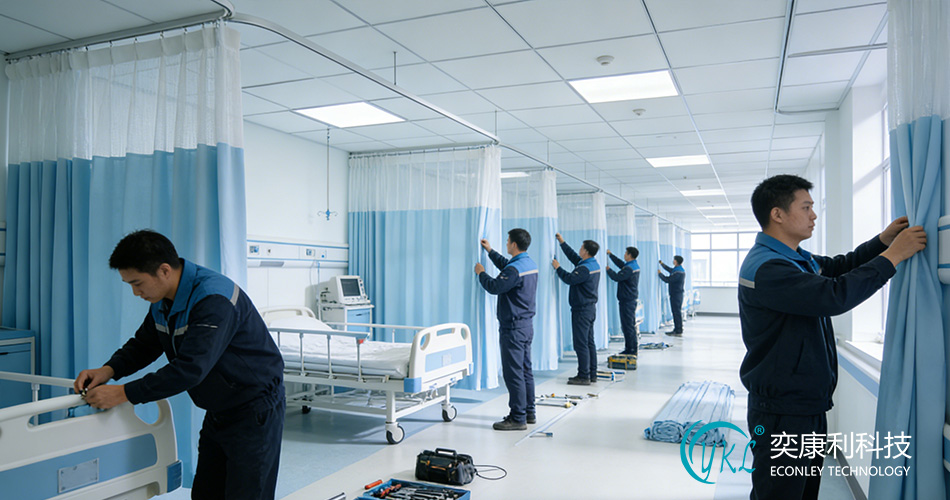
The installation of partition curtains is a high-precision process that extends far beyond simply hanging a piece of fabric. In a clinical environment, specialized hardware and meticulous mounting techniques are mandatory; a poorly installed curtain is not just an aesthetic failure, but a significant safety hazard that can impede emergency response or snag during critical patient transfers.
Selecting the correct track architecture is the first step in a successful deployment. At Econley, we categorize hardware solutions based on the facility’s structural requirements:
Low-Profile Ceiling Mounted Tracks: These offer the cleanest architectural look and are the industry standard for permanent cubicles. They are bolted directly into the ceiling grid, providing maximum stability for high-usage wards.
Structural Suspended Tracks: In modern facilities with high industrial ceilings or exposed HVAC ductwork, suspended tracks are utilized. These use rigid drop-rods to maintain a consistent curtain height, ensuring privacy isn't compromised by architectural voids.
Quiet-Glide Wheeled Carriers: Patient recovery requires a low-decibel environment. Our carriers utilize "quiet-glide" nylon wheels and stainless-steel hooks to minimize noise pollution, allowing nurses to draw curtains without disturbing resting patients.
To ensure your installation of partition curtains meets international healthcare codes, follow these three technical benchmarks:
Precision Clearance Measurement: Always measure from the track to approximately 10-15 inches (25-38cm) above the finished floor. This specific gap is required to allow floor-cleaning robots and mops to pass underneath without contaminating the fabric, while also preventing trip hazards for staff.
Fire Sprinkler Alignment: During the installation of partition curtains, the 20-inch mesh header must be perfectly aligned with the ceiling’s fire suppression sensors. This ensures that in the event of a fire, water from the sprinklers can penetrate the cubicle unimpeded.
Structural Load Rating: We recommend heavy-duty extruded aluminum tracks with a minimum wall thickness of 2.0mm. This prevents "track sagging" over time, ensuring the flame retardant standards for partition curtains are supported by a frame that can handle the constant mechanical stress of a 24/7 hospital environment.
Econley Technology is a leading B2B supplier based in China, providing comprehensive OEM and ODM services. We are ISO 9001:2015 certified and specialize in manufacturing curtains that meet international medical standards. We currently support multiple B2B manufacturing and technology brands across Europe and North America.
In the US, NFPA 701 is the mandatory standard. In Europe, curtains must typically meet BS 5867 Part 2 Type B/C or local equivalents like the French M1 or German B1. Econley products are tested to meet all three major global standards, ensuring your facility is compliant regardless of location.
Yes. We understand that medical procurement requires physical validation. Econley provides free swatches and small sample panels for flame-spread testing and antimicrobial validation upon request for verified B2B wholesalers and hospital procurement officers.
 Tel :13510328459
 Email :493432861@qq.com
 Phone :0755-82154850/25907050
 Add:205-206, 2nd Floor, Building 2, Xiazao Village Industrial Zone, Gaofeng Community, Dalang Street, Longhua District, Shenzhen City

About

Products
Cases
News
Contact
 493432861@qq.com