Service Hotline:13510328459
 205-206, 2nd Floor, Building 2, Xiazao Village Industrial Zone, Gaofeng Community, Dalang Street, Longhua District, Shenzhen City
Service Hotline:13510328459
205-206, 2nd Floor, Building 2, Xiazao Village Industrial Zone, Gaofeng Community, Dalang Street, Longhua District, Shenzhen City



Time:2026-01-19 Preview:
Bathrooms are high-risk areas for falls, making accessibility handrails a non-negotiable safety feature for residential, commercial, and healthcare facilities. Bathroom Accessibility Handrail Installation Images serve as an indispensable visual guide for installers, facility managers, homeowners, and designers, translating complex installation requirements into clear, actionable visuals. Unlike generic product photos, these images focus specifically on the installation process, mounting details, and spatial adaptation in bathroom environments—from toilet and shower areas to sink zones. For anyone tasked with installing or overseeing the installation of bathroom accessibility handrails, these images eliminate ambiguity, ensure compliance with accessibility standards, and guarantee the handrails function as intended to protect users. This article explores the core value, scenario-specific installation showcases, professional shooting guidelines, reliable acquisition channels, and practical application strategies of Bathroom Accessibility Handrail Installation Images.
The primary value of Bathroom Accessibility Handrail Installation Images lies in simplifying complex installation processes and ensuring safety. Bathroom environments present unique challenges—humid conditions, varying wall materials (tile, drywall, concrete), and the need to align with ergonomic requirements for different users. These images provide step-by-step visual guidance on critical installation steps, such as locating wall studs, drilling pilot holes, mounting brackets, and securing the handrail, helping installers avoid common mistakes like unstable mounting or incorrect placement. For DIY homeowners or less experienced installers, this visual support reduces the risk of installation failures that could lead to handrail collapse and user injuries.
Another key value is ensuring compliance with accessibility standards. Bathroom accessibility handrails must adhere to strict guidelines (such as ADA, ISO 14122) regarding height, distance from walls, and installation position. Bathroom Accessibility Handrail Installation Images clearly demonstrate how to install handrails to meet these standards, providing visual evidence of correct placement—for example, the proper height of toilet-side handrails or the required clearance between a shower handrail and the wall. This helps facility managers and installers avoid regulatory penalties and ensures the handrails are truly accessible to users with disabilities, the elderly, or those with mobility limitations.
Bathroom Accessibility Handrail Installation Images for toilet areas focus on the precise placement and mounting of handrails to support sitting and standing movements. These images showcase the correct installation of horizontal and vertical handrail combinations, highlighting the distance between the handrail and the toilet, the height from the floor, and the secure attachment to wall studs or reinforced mounting blocks. They also illustrate how to avoid obstacles like toilet paper holders or bidets, ensuring the handrail is easily accessible without hindering other bathroom functions. For wall-mounted toilets or fragile wall materials, the images may include special mounting techniques, such as using toggle bolts or reinforced backplates, to ensure stability.
Shower and bathtub areas require specialized installation to withstand wet conditions and support users on slippery surfaces, and Bathroom Accessibility Handrail Installation Images for these zones emphasize water-resistant mounting and multi-angle support. The images showcase the installation of grab bars near shower entrances, along shower walls, and on bathtub edges, highlighting the use of corrosion-resistant fasteners and waterproof sealants to prevent water damage to walls. They also demonstrate how to install handrails at different heights to accommodate standing users and those seated on shower benches, ensuring comprehensive support during bathing activities. Close-up shots of bracket connections and waterproofing details help installers ensure long-term durability in humid environments.
In sink and grooming areas, Bathroom Accessibility Handrail Installation Images focus on balancing support with functionality. These images show the installation of horizontal handrails beside sinks, ensuring they are positioned at a height that allows users to maintain balance while washing hands or grooming, without blocking access to the sink or faucet. They also illustrate how to mount handrails on walls with limited space, such as narrow bathroom vanities, using compact brackets or foldable designs. For users with limited upper limb mobility, the images may showcase handrails with extended grips or strategic placement to provide maximum support during grooming tasks.
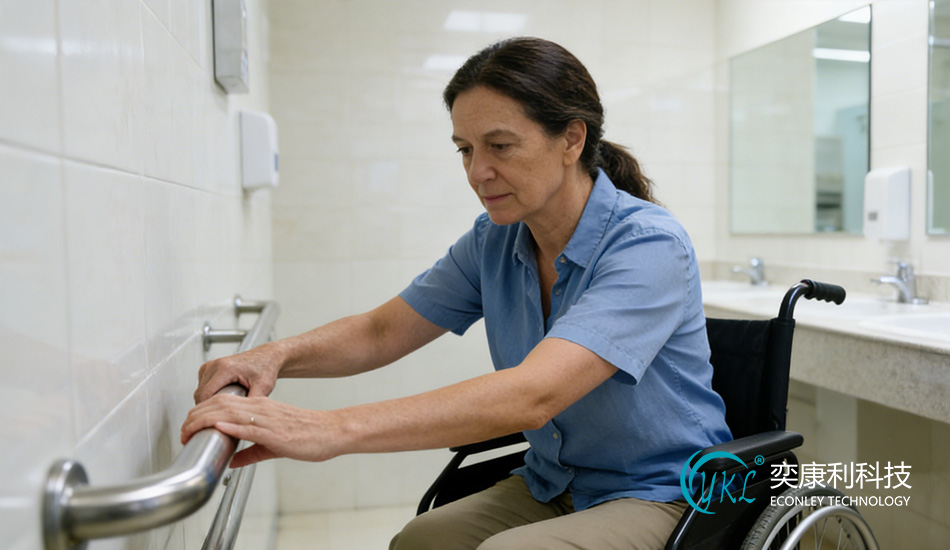
To maximize the utility of Bathroom Accessibility Handrail Installation Images, professional shooting is essential. Firstly, prioritize clarity and detail: use high-resolution cameras to capture close-up shots of critical installation steps, such as stud location, bracket mounting, and fastener tightening. Ensure lighting is even to avoid shadows that could obscure details, especially in small bathroom spaces. Secondly, showcase real installation scenarios: shoot in actual bathrooms with different wall materials and layouts to reflect the diverse environments installers may encounter, rather than studio settings.
Thirdly, highlight compliance and safety details: include visual markers (such as measuring tapes or level tools) in images to demonstrate correct height and alignment, without revealing specific product parameters. Clearly show the difference between correct and incorrect installations (e.g., a securely mounted bracket vs. a loosely attached one) to help installers identify and avoid mistakes. Additionally, organize images sequentially for step-by-step guidance, from pre-installation preparation (stud finding) to post-installation inspection (handrail stability testing), ensuring logical flow for users following the visual guide.
Obtaining high-quality, accurate Bathroom Accessibility Handrail Installation Images requires selecting reliable channels. Firstly, official manufacturer websites are a primary source: reputable accessibility handrail manufacturers often provide detailed installation guides with accompanying images, tailored to their specific products and bathroom applications. These images are designed to align with the manufacturer’s installation recommendations and accessibility standards. Secondly, home improvement and DIY platforms feature curated installation image galleries, often created by professional installers or experienced homeowners, showcasing real-world installation projects and tips.
Thirdly, accessibility and construction resource platforms offer comprehensive collections of Bathroom Accessibility Handrail Installation Images, paired with compliance guidelines and best practices. These platforms are particularly useful for facility managers and designers seeking images that meet regulatory requirements. Additionally, professional installation service providers may share case studies with installation images, demonstrating their expertise and the quality of their work. For custom installation scenarios, direct collaboration with manufacturers or professional photographers can result in tailored images that address specific bathroom layout or material challenges.
To fully leverage the value of Bathroom Accessibility Handrail Installation Images, stakeholders can adopt targeted application strategies. For installers, use the images as a real-time reference during installation, cross-referencing each step with the visual guide to ensure accuracy. For facility managers, incorporate the images into installer training programs, using them to standardize installation processes and ensure consistency across multiple bathrooms. Pairing images with written installation manuals enhances comprehension, especially for new or less experienced team members.
For homeowners undertaking DIY installations, select images that match their bathroom layout and handrail type, and use them to plan the installation process in advance—identifying potential challenges like wall material or space constraints. For designers and architects, include Bathroom Accessibility Handrail Installation Images in project proposals to help clients visualize the installation process and final result, ensuring alignment with design aesthetics and accessibility goals. Regularly updating image libraries to include new installation techniques or compliance requirements ensures the visual guides remain relevant and effective.
Bathroom Accessibility Handrail Installation Images are more than just visual aids—they are critical tools for ensuring safe, compliant, and effective handrail installation in high-risk bathroom environments. By providing clear, detailed guidance on scenario-specific installation, these images empower installers, protect users, and support compliance with accessibility standards. Whether for residential bathrooms, commercial facilities, or healthcare settings, investing in high-quality installation images is a key step in creating safe, inclusive bathroom spaces. If you need guidance on obtaining or creating professional Bathroom Accessibility Handrail Installation Images tailored to your needs, contact us today to connect with experts in accessibility installation and visualization.
 Tel :13510328459
 Email :493432861@qq.com
 Phone :0755-82154850/25907050
 Add:205-206, 2nd Floor, Building 2, Xiazao Village Industrial Zone, Gaofeng Community, Dalang Street, Longhua District, Shenzhen City

About

Products
Cases
News
Contact
 493432861@qq.com