Service Hotline:13510328459
 205-206, 2nd Floor, Building 2, Xiazao Village Industrial Zone, Gaofeng Community, Dalang Street, Longhua District, Shenzhen City
Service Hotline:13510328459
205-206, 2nd Floor, Building 2, Xiazao Village Industrial Zone, Gaofeng Community, Dalang Street, Longhua District, Shenzhen City



Time:2026-01-15 Preview:
Nursing homes are dedicated to providing a safe, comfortable, and dignified living environment for elderly residents, many of whom face mobility challenges such as weakened muscle strength, balance disorders, or visual impairments. Nursing Home Handrail Installation Design Plans serve as a foundational guide for constructing a comprehensive barrier-free support system, integrating ergonomic principles, safety standards, and the unique needs of the elderly into actionable installation strategies. Unlike generic building handrail designs, these specialized plans prioritize adaptability to the physical limitations of senior residents and the diverse functional scenarios of nursing homes—from corridors and bedrooms to bathrooms and activity areas. This article explores the core value, scenario-specific design points, elderly-centered adaptation principles, implementation processes, and optimization strategies of Nursing Home Handrail Installation Design Plans, providing practical guidance for nursing home administrators, architects, and construction teams.
The primary value of Nursing Home Handrail Installation Design Plans lies in safeguarding the safety and independence of elderly residents. Falls are one of the most common safety hazards in nursing homes, and a well-designed handrail system can significantly reduce fall risks by providing stable support during daily movements. These plans ensure that handrails are installed in key positions and designed to fit the elderly’s ergonomic needs, enabling semi-independent residents to move freely between rooms, dining areas, and activity spaces without excessive reliance on caregivers. This not only enhances residents’ quality of life but also alleviates the workload of care staff.
Another key value is ensuring compliance with elderly care facility standards and regulations. Reputable Nursing Home Handrail Installation Design Plans are developed in alignment with national and international standards for barrier-free design, such as ISO 14122 and local elderly care facility safety codes. Compliance with these standards ensures that the handrail system meets requirements for load-bearing capacity, anti-slip performance, and accessibility, helping nursing homes avoid regulatory penalties and enhance their overall service quality rating. Additionally, a systematic design plan facilitates consistent implementation across the entire facility, ensuring uniform safety standards in every area.
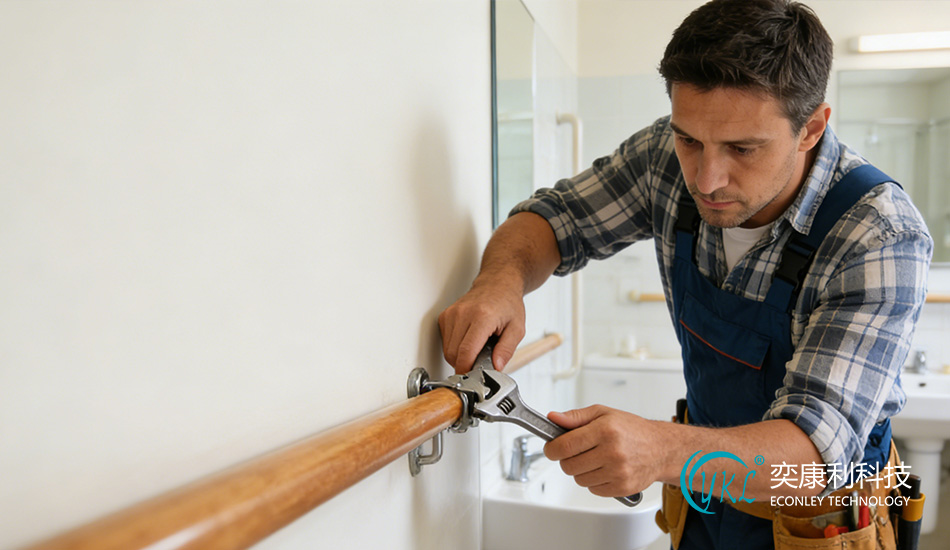
Nursing Home Handrail Installation Design Plans for corridors prioritize continuity and accessibility. The plans specify continuous handrail installation along both sides of the corridor, with no breaks at intersections or doorways, to provide uninterrupted support. The height of the handrails is calibrated to fit the average arm length of the elderly, and many plans recommend dual-level handrails to accommodate residents of different heights and those using wheelchairs. The design also includes tactile guidance marks on handrails to assist visually impaired residents in identifying directions and key locations, such as medical stations or rest areas.
Bathrooms and showers are high-risk areas for falls due to wet surfaces, so Nursing Home Handrail Installation Design Plans for these spaces focus on anti-slip performance and multi-angle support. The plans specify the installation of U-shaped or L-shaped handrails around toilets to assist residents in sitting down and standing up, and vertical handrails near shower entrances and seats to provide stability during bathing. The design also includes moisture-resistant materials and reinforced wall mounting to ensure durability in humid environments, as well as smooth surfaces that are easy to clean and disinfect.
In bedrooms, Nursing Home Handrail Installation Design Plans emphasize personalized support and privacy. Handrails are installed near beds to help residents get in and out of bed safely, with adjustable height options to meet individual needs. The plans also ensure that handrail installation does not interfere with the placement of medical equipment or the movement of caregivers. In private bathrooms attached to bedrooms, the design maintains consistency with public bathroom standards while considering the intimate space requirements of residents, avoiding overly intrusive installations.
For nursing homes with multiple floors, Nursing Home Handrail Installation Design Plans for stairwells and ramps focus on stability and ease of use. Stairwells are equipped with dual-level handrails that extend beyond the start and end of the stairs, allowing residents to grasp them before stepping onto the stairs. Ramps feature continuous handrails on both sides, with appropriate spacing to accommodate wheelchairs and walkers. The design also includes anti-slip surface treatment for handrails to ensure a secure grip even in wet conditions.

High-quality Nursing Home Handrail Installation Design Plans adhere to three core elderly-centered principles. Firstly, ergonomic adaptability: handrail height, grip diameter, and surface texture are all designed to fit the physical characteristics of the elderly. The grip diameter is optimized to ensure comfort for residents with weak hand strength, and the surface is treated with a soft, non-slip texture to prevent slipping. Secondly, safety optimization: all handrail edges are rounded to avoid scratches, and mounting brackets are concealed to prevent clothing from getting caught. Thirdly, emotional comfort: the design avoids a cold clinical appearance, using warm colors and natural textures to blend with the nursing home’s decor, creating a homely atmosphere.
The successful implementation of Nursing Home Handrail Installation Design Plans involves four key stages. Firstly, needs assessment: conduct a comprehensive evaluation of the resident population, including their mobility levels, physical conditions, and specific needs, to customize the design plan. Secondly, plan finalization: collaborate with architects, occupational therapists, and caregivers to revise and finalize the plan, ensuring it meets both safety standards and practical care needs. Thirdly, professional installation: select a construction team with experience in elderly care facility projects to implement the plan, ensuring strict adherence to design details such as handrail height and mounting stability. Fourthly, post-installation verification: conduct on-site inspections to test handrail stability, anti-slip performance, and compliance with design requirements, and collect feedback from residents and caregivers to make necessary adjustments.
Nursing Home Handrail Installation Design Plans should be continuously optimized based on actual use and changes in resident needs. Regularly collect feedback from residents and caregivers to identify areas for improvement, such as adjusting handrail height for specific groups or adding handrails in newly identified high-risk areas. With the advancement of technology, design plans can also integrate smart elements, such as handrails with built-in call buttons to enable residents to seek help quickly. Additionally, when renovating or expanding the nursing home, the design plan should be updated to maintain consistency with the overall facility layout and the latest safety standards.
Nursing Home Handrail Installation Design Plans are a critical component of building a safe and humanistic elderly care environment. By focusing on scenario-specific needs, adhering to elderly-centered principles, and following a rigorous implementation process, these plans ensure that handrails effectively support residents’ mobility and safety. For nursing home administrators seeking to enhance the safety and quality of care services, investing in professional Nursing Home Handrail Installation Design Plans is an essential step. If you need personalized design plan customization or professional guidance for handrail installation, contact us today. We will connect you with expert teams to develop a tailored solution that meets the unique needs of your nursing home and residents.
 Tel :13510328459
 Email :493432861@qq.com
 Phone :0755-82154850/25907050
 Add:205-206, 2nd Floor, Building 2, Xiazao Village Industrial Zone, Gaofeng Community, Dalang Street, Longhua District, Shenzhen City

About

Products
Cases
News
Contact
 493432861@qq.com