Service Hotline:13510328459
 205-206, 2nd Floor, Building 2, Xiazao Village Industrial Zone, Gaofeng Community, Dalang Street, Longhua District, Shenzhen City
Service Hotline:13510328459
205-206, 2nd Floor, Building 2, Xiazao Village Industrial Zone, Gaofeng Community, Dalang Street, Longhua District, Shenzhen City



Time:2026-01-12 Preview:
Inclusive healthcare has become a global consensus, and accessible handrails, as a key part of hospital barrier-free facilities, directly affect the independent medical experience of people with disabilities, the elderly, and other groups with limited mobility. European & American Hospital Accessibility Handrail Cases have formed mature and humanized solutions through long-term practice, integrating strict compliance standards, diverse user needs, and spatial environment coordination. These cases not only reflect the advanced concept of "design for all" but also provide valuable practical references for global medical institutions to optimize barrier-free facilities. This article deeply interprets European & American Hospital Accessibility Handrail Cases, explores their scenario adaptation characteristics, design concepts, compliance logic, and practical enlightenment, helping relevant professionals grasp the core points of high-quality hospital accessibility handrail construction.
The primary value of European & American Hospital Accessibility Handrail Cases lies in bridging the gap between theoretical standards and practical application. International barrier-free design standards such as ADA (Americans with Disabilities Act) and ISO 14122 are abstract in content, while these cases vividly show how to translate standard requirements into specific handrail design and installation solutions. For example, how to balance the safety support of handrails with the smooth flow of medical staff and equipment, and how to adapt to the diverse needs of different disabled groups.
Another key value is providing scalable experience for different types of hospitals. Whether it is a large comprehensive hospital, a professional rehabilitation hospital, or a community medical institution, European & American Hospital Accessibility Handrail Cases have targeted solutions. These cases fully consider the differences in traffic flow, functional layout, and service groups of different hospitals, ensuring that the accessibility handrail system can play a practical role in various medical scenarios. At the same time, they also reflect the humanistic care of European and American hospitals, taking the independent participation and dignity of people with disabilities as the core of design.
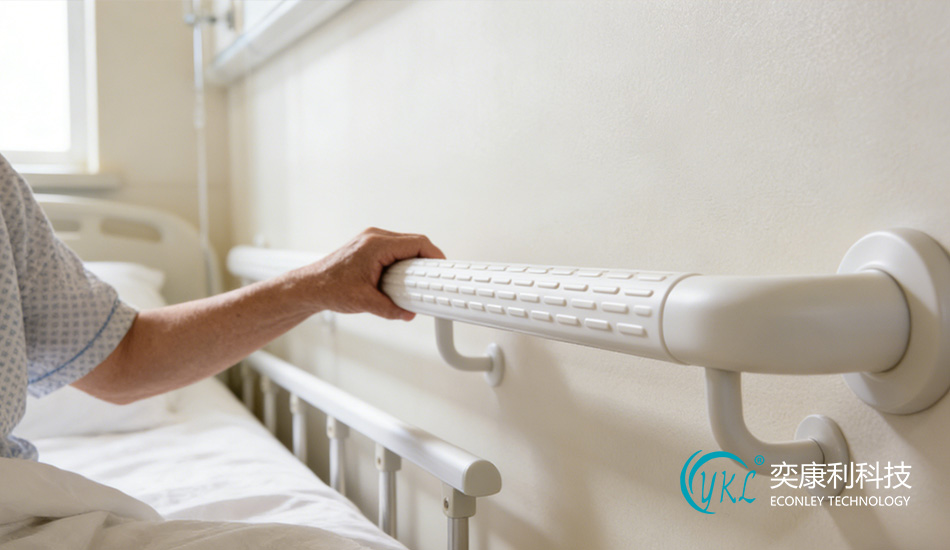
American Spaulding Rehabilitation Hospital, once rated as the "Best Rehabilitation Hospital in the United States", has set a benchmark in the design of accessibility handrails . In its rehabilitation training area, the handrail system is designed with adjustable height and angle. Different from fixed handrails, these handrails can be flexibly adjusted according to the recovery stage of patients, whether it is for walking training or balance training. The handrail surface adopts a non-slip texture design, which ensures a firm grip even when patients' hands are weak. In the outdoor landscape trail of the hospital, continuous handrails are installed on both sides of the wheelchair channel, which are connected with the indoor handrail system to form a seamless barrier-free path, allowing patients to carry out rehabilitation training in a natural environment.
European hospitals represented by Berlin, Germany, focus on the continuity and guiding function of accessibility handrails in public passage areas . In the corridors of Berlin's comprehensive hospitals, handrails run through the entire passage, and the connection with walls and corners adopts seamless design to avoid obstacles. For visually impaired patients, the handrails are designed with high-contrast colors, and tactile prompts are set at key positions such as turns and elevators—consistent with the ground tactile paving, forming a dual guidance of touch and vision. In addition, the handrails near the elevator are extended to the elevator door, and the height is precisely matched with the wheelchair user's sitting posture, making it easier for patients to grasp and transfer.
In the bathroom and toilet areas of European and American hospitals, accessibility handrail cases show precise targeted design. Similar to the detailed design of Japanese hospital bathrooms, European and American hospitals also configure multi-angle handrails around toilets and showers . For example, in the toilets of London's public hospitals, U-shaped handrails are installed on both sides of the toilet, and a vertical handrail is added on one side of the wall to assist patients in sitting down and standing up. The handrail surface is made of corrosion-resistant and easy-to-clean materials, which can withstand frequent disinfection and meet the hygiene requirements of medical environments. In the hydrotherapy area of American rehabilitation hospitals, the handrails are installed at the edge of the pool, and the part in contact with water adopts anti-slip and anti-rust materials, which not only assists patients in entering and exiting the pool safely but also does not affect the use of hydrotherapy equipment.
A typical case in the UK is the Stairsteady handrail designed for narrow stairwells . This handrail is widely used in small and medium-sized European hospitals and community medical institutions with limited space. It consists of a fixed track and a movable handle—the handle can slide along the track when in use, and automatically locks when stopped, ensuring the safety of patients when going up and down stairs. The foldable design allows it to be stored when not in use, without occupying additional space, which is particularly suitable for old hospital renovation projects. This case fully reflects the European design concept of adapting to limited space while ensuring accessibility.
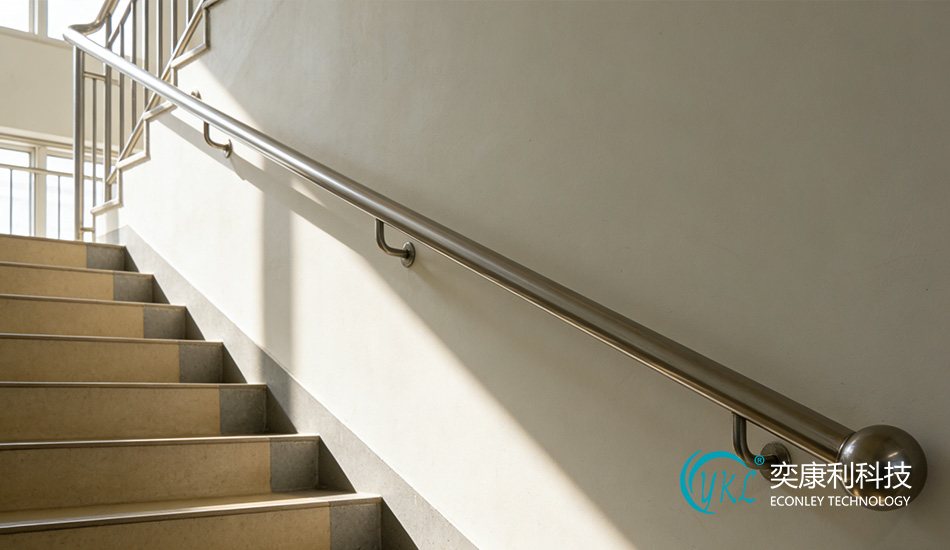
European & American Hospital Accessibility Handrail Cases are based on the core concept of "universal design", aiming to meet the needs of different groups without special distinction . This concept is reflected in the cases: the handrail height is compatible with both standing users and wheelchair users, the grip diameter is suitable for most people's hand sizes, and the material selection takes into account the safety of children and the elderly. In terms of compliance, all cases strictly follow local and international standards—American cases comply with ADA standards, ensuring the load-bearing capacity and anti-slip performance of handrails; European cases follow the Berlin Building Regulations Amendment, which clearly requires that handrails in medical buildings must adapt to the needs of people with disabilities, the elderly, and children .
These cases also attach great importance to the coordination between handrails and the overall medical environment. The color, material, and shape of handrails are consistent with the interior design of the hospital, avoiding the sense of abruptness of functional facilities, and reducing the psychological pressure of patients. For example, the handrails in pediatric hospitals adopt soft colors and rounded shapes, which are in line with children's aesthetic habits and reduce their fear of medical environments.
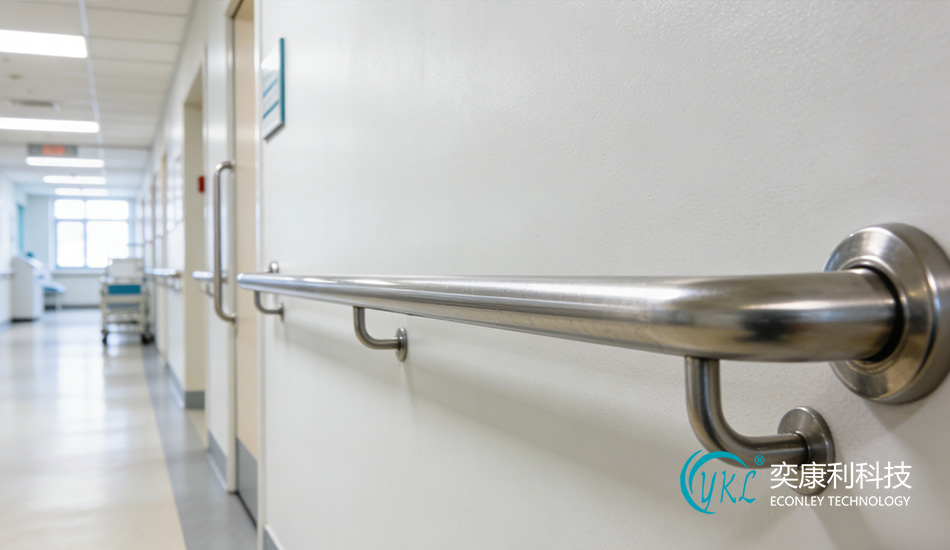
Learning from European & American Hospital Accessibility Handrail Cases, global medical institutions should focus on three core points in the construction of barrier-free handrails: first, take user demand as the core, conduct in-depth research on the mobility characteristics of different groups, and avoid one-size-fits-all design; second, pay attention to the connection of facilities, forming a seamless barrier-free system between handrails and other facilities such as ramps, elevators, and tactile paving; third, balance functionality and environment, making accessibility handrails not only safe and practical but also integrated into the overall space of the hospital.
For old hospital renovation projects, the space-saving design concepts in European cases (such as foldable handrails) can be learned from to realize the upgrading of barrier-free facilities under limited conditions. For new hospitals, the systematic design experience of American rehabilitation hospitals can be referenced to build a full-scenario accessibility handrail system covering rehabilitation training, daily medical treatment, and other links.
European & American Hospital Accessibility Handrail Cases are the practice crystallization of inclusive healthcare concepts, which provide important references for improving the level of global hospital barrier-free construction. By learning from these cases, medical institutions can better protect the independent medical rights of people with disabilities and the elderly, and build a more equitable and humanistic medical environment. If you need to obtain more detailed European & American Hospital Accessibility Handrail Cases or professional barrier-free design consultation, contact us today. We will provide you with targeted case materials and technical support to help you implement high-quality barrier-free handrail solutions in medical spaces.
 Tel :13510328459
 Email :493432861@qq.com
 Phone :0755-82154850/25907050
 Add:205-206, 2nd Floor, Building 2, Xiazao Village Industrial Zone, Gaofeng Community, Dalang Street, Longhua District, Shenzhen City

About

Products
Cases
News
Contact
 493432861@qq.com