Service Hotline:13510328459
 205-206, 2nd Floor, Building 2, Xiazao Village Industrial Zone, Gaofeng Community, Dalang Street, Longhua District, Shenzhen City
Service Hotline:13510328459
205-206, 2nd Floor, Building 2, Xiazao Village Industrial Zone, Gaofeng Community, Dalang Street, Longhua District, Shenzhen City



Time:2026-01-09 Preview:
When you tour a nursing home, you might notice the cleanliness or the friendliness of the staff. While these are crucial, a silent caregiver in every hallway and bathroom often reveals more about a facility’s dedication to safety: the accessibility rail.
More than simple supports, these rails signify a commitment to proactive fall prevention. A sturdy, properly installed rail can be the one thing that prevents a minor stumble from becoming a serious injury by providing stability where it’s needed most.
This guide will help you learn what to look for, transforming you from a worried visitor into an empowered advocate who can ask the right questions to ensure your loved one's safety.
While they might look similar, the long rail in a hallway and the short bar in a bathroom serve two different, critical purposes. Confusing them can create a hidden danger, and knowing the difference is the first step toward becoming an advocate for your loved one.
A hallway handrail is a guide. It’s a continuous, steadying partner for someone walking from their room to the dining hall, offering light balance and support. In contrast, a bathroom grab bar is an anchor. It’s shorter, thicker, and engineered to support a person's full body weight during moments of leverage, like standing up from the toilet or stepping into a shower.
This distinction is crucial because a handrail is not built for the sudden force of a person pulling on it to prevent a fall—that’s a grab bar’s job. Using the wrong type of rail can lead to equipment failure and serious injury.

A well-designed hallway handrail is a lifeline that improves resident mobility. When touring a facility, you can quickly gauge its commitment to safety by performing this simple check.
First, notice if the rail runs uninterrupted down the entire length of the hall. For someone relying on it, a gap or a break is like a bridge suddenly ending. This continuous design ensures a resident always has a steadying hand to hold.
Next, run your own hand along the rail. Is there enough room between the rail and the wall for your knuckles? Proper grip clearance allows a person to wrap their hand completely around the rail for a secure hold.
Finally, and most importantly, perform a stability test. Give the rail a firm shake in several places. It should be rock-solid. Any wiggle, give, or looseness is a major red flag indicating poor installation and a serious fall risk.
Your 3-Point Safety Check:
Is it continuous? No gaps or breaks.
Can you get a full grip? Knuckles don’t scrape the wall.
Is it rock-solid? Zero wiggle or movement.
While hallway support is critical, the moments requiring the most strength often happen in the bathroom.
Safely using a toilet requires both balance and strength, which is why a single grab bar often isn’t enough. The first essential component is a long bar mounted on the wall behind the toilet. This back bar provides a steady anchor to hold as a person lowers themselves onto the seat.
To complete this safety zone, a second bar must be installed on the nearest side wall. While the back bar helps with sitting down, this side bar is for standing up. It’s positioned to provide the leverage needed to pull oneself to a standing position with confidence. The guidance on where to install grab bars is calculated for optimal support during this motion.
Together, these two bars create a secure support system for one of the most common daily activities. This thoughtful placement promotes dignity by allowing residents to manage their own needs safely.
Stepping into a wet shower is one of the riskiest moments for a senior. A grab bar provides a handhold, but its effectiveness plummets if the surface is smooth. Imagine trying to grip a wet, polished pipe—your hand could easily slip at the exact moment you need support. A slick bar in a wet area is a fall hazard, no matter how sturdy it seems.
This is why safe shower grab bars are never perfectly smooth. Instead, look for a bar with a textured finish, often called a "peened" or "knurled" grip. This intentional roughness provides the friction needed for wet hands to maintain a secure, non-slip grip, turning a potential hazard into a reliable safety tool.
The bar's material is also critical. The best grab bars for seniors are made from stainless steel because it’s strong and won't rust. Be wary of shiny, chrome-plated bars that get dangerously slippery, or decorative plastic bars that may lack the strength needed in an emergency.
Beyond knowing what makes a rail safe, it’s crucial to recognize common hazards. The most common one hides in plain sight: the bathroom towel rack. It’s designed to hold a towel, not the weight of a person. Grabbing it for support can rip it from the wall, turning a slip into a serious injury.
You may also encounter suction cup grab bars, sometimes presented as easy alternatives to permanent grab bars. These are notoriously unreliable. Humidity can cause them to lose suction and detach without warning. A true safety rail is always anchored securely into the wall’s structure.
Finally, trust your hands and eyes. Any rail that feels loose or wiggles under firm pressure is an immediate red flag. A rail that’s too low or high also forces an awkward, unstable posture. These are not minor details—they are the difference between support and a hazard.
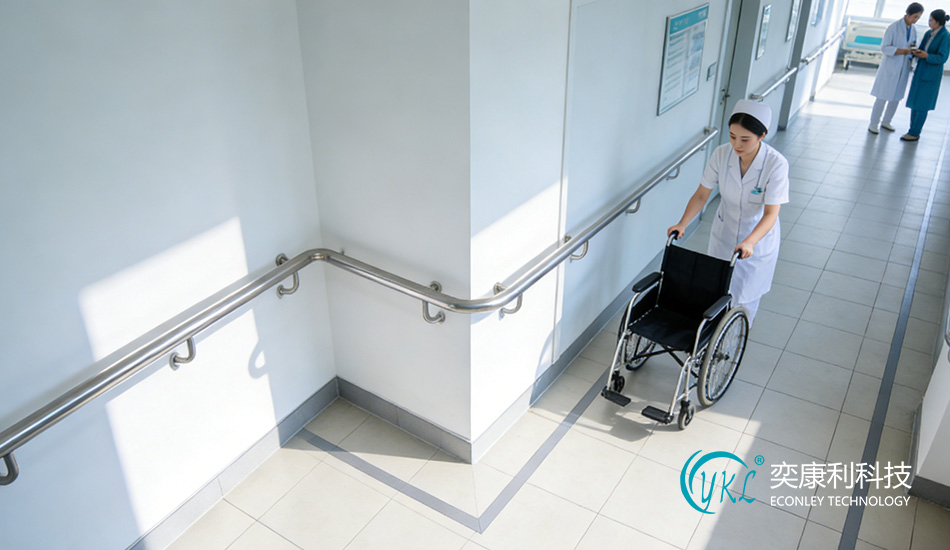
You no longer just see rails on a wall; you now see a direct reflection of a facility’s commitment to safety and dignity. To transform this insight into action, use this checklist of targeted questions on your next visit. The responses will speak volumes.
Your Action Checklist: 5 Questions for Staff
How do you ensure hallway handrails are continuous and securely anchored?
Are all bathroom grab bars professionally installed to support a person's full weight?
Do your shower and bath grab bars have a textured finish for a secure grip when wet?
What is your policy on residents using temporary or suction-cup grab bars?
How often do you inspect every accessibility rail for looseness or damage?
A sturdy, well-placed rail is not a minor detail—it is a cornerstone of independence and a powerful sign of a facility that truly cares. You are now equipped to see it, and to ask about it, with confidence.
 Tel :13510328459
 Email :493432861@qq.com
 Phone :0755-82154850/25907050
 Add:205-206, 2nd Floor, Building 2, Xiazao Village Industrial Zone, Gaofeng Community, Dalang Street, Longhua District, Shenzhen City

About

Products
Cases
News
Contact
 493432861@qq.com