Service Hotline:13510328459
 205-206, 2nd Floor, Building 2, Xiazao Village Industrial Zone, Gaofeng Community, Dalang Street, Longhua District, Shenzhen City
Service Hotline:13510328459
205-206, 2nd Floor, Building 2, Xiazao Village Industrial Zone, Gaofeng Community, Dalang Street, Longhua District, Shenzhen City



Time:2026-01-09 Preview:
A hospital handrail is far more than a simple bar on a wall; for a patient feeling weak or unsteady, it’s a lifeline. Its effectiveness isn't an accident but the result of thoughtful ergonomic design. This careful approach is fundamental to improving patient safety by turning a passive object into an active partner in care.
Have you ever noticed the specific shape? It’s engineered to be a perfect “Goldilocks” size—not too thick and not too thin—so even a weak or arthritic hand can find a secure hold. Research shows that the deliberate gap between the rail and the wall also serves a critical purpose, giving knuckles enough clearance to prevent painful pinching or scrapes.
Ultimately, this smooth, rounded surface creates a continuous path for patient mobility. It allows a person to glide their hand along its entire length without interruption, providing the uninterrupted support and confidence needed to navigate the corridor safely.
That consistent height on hospital handrails isn’t a coincidence. The placement is carefully calculated to serve as many people as possible, an approach known as universal design. For someone walking, the rail offers stability at a natural arm level. For a person using a wheelchair, that same height provides a crucial point to grip and help maneuver. It’s a clever compromise that makes the hallway safer for a wider range of people.
This commitment to accessibility is so important that it’s formalized in regulations like the Americans with Disabilities Act (ADA). These requirements ensure that buildings are constructed to be safe and usable for people with varying physical abilities. The handrail’s standardized height and clearance from the wall are a direct result of these thoughtful rules, guaranteeing a predictable support system in any modern hospital.
You’ll also notice that wider corridors have handrails on both sides. Imagine feeling dizzy in the middle of a broad hallway; support needs to be just a step or two away, no matter which direction you turn. By lining both walls, the design ensures help is always within reach. But physical stability is only half the battle.
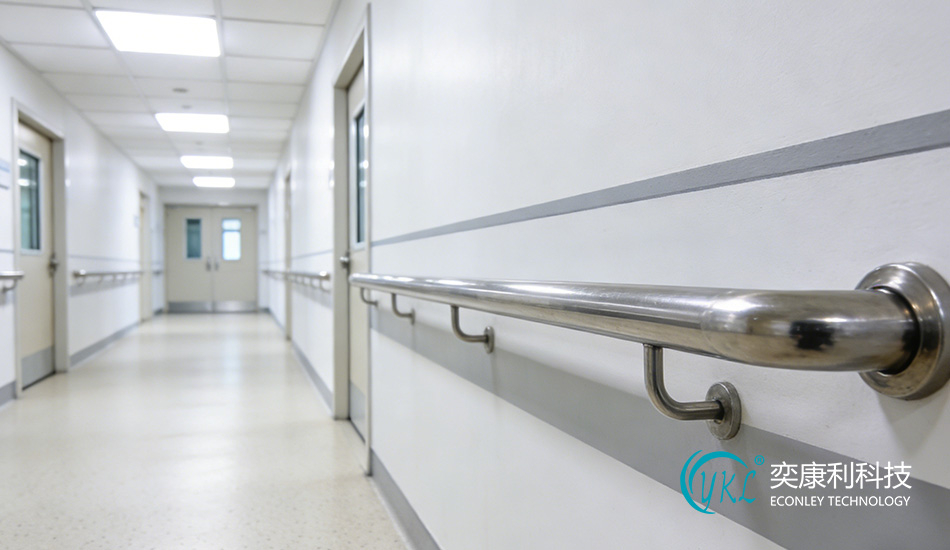
Beyond physical stability, a handrail’s most critical job is to prevent the spread of infection. Hundreds of different hands touch it every day, making material choice a life-or-death decision. The secret lies in using a non-porous surface. Think of the difference between a wooden cutting board, with tiny grooves where bacteria can hide, and a smooth glass countertop. Hospital handrails are like that countertop—perfectly smooth, leaving germs with nowhere to take root and making disinfection fast and effective.
This is precisely why you'll often see sturdy vinyl or stainless steel handrails for clinics and hospitals. Unlike porous materials like wood or stone, these options provide a seamless surface that can be wiped clean in seconds. While stainless steel is known for its raw durability, modern vinyl systems offer warmth to the touch and a wide range of colors, all without sacrificing the cleanability that is absolutely essential in a healthcare environment.
Taking this protection a step further, many modern antimicrobial handrail systems have germ-fighting properties built directly into the material. These surfaces don’t just make it easy to wipe germs away; they actively inhibit the growth of bacteria, fungi, and mold between cleanings. This invisible shield provides a constant line of defense against pathogens. But this defense against microscopic threats is matched by the rail’s ability to withstand major physical force.
A handrail’s true test comes in a moment of crisis. Imagine a patient stumbling and grabbing the rail with their full weight. It can’t just be "sturdy"; it must be engineered to hold hundreds of pounds without question. This incredible strength is a strict safety requirement, ensuring the rail acts as a reliable lifeline when it's needed most. It’s a level of support that goes far beyond what you’d find in a typical home.
Look lower down a hospital wall, and you'll often spot a second, thicker rail. That's a "crash rail"—a durable bumper protecting walls from the constant impact of gurneys and carts. These hospital wall protection and handrail combos are designed to absorb force, keeping the building itself safe and intact amidst the daily bustle of a busy medical center.
This life-saving strength relies on powerful, code compliant handrail brackets for hospitals anchored deep into the wall structure. To ensure safety for everyone, some systems are even built to stricter bariatric support railing specifications. But strength alone isn't enough; the rail's very shape is designed to prevent a different kind of accident.
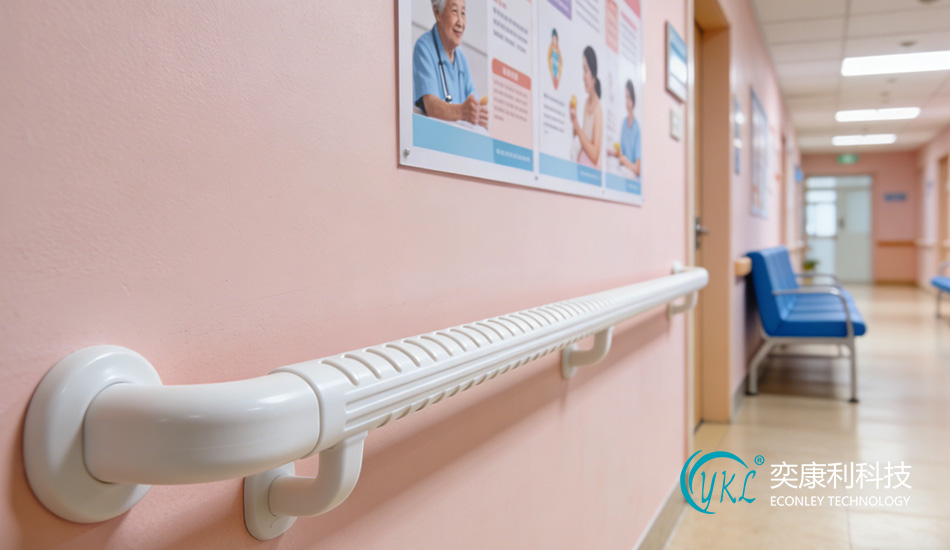
While a handrail’s strength is vital, its shape is just as important for safety. Consider how a hospital handrail doesn't just end abruptly; it almost always makes a smooth, 180-degree turn to connect back to the wall. This feature, known as an "end return," isn’t a stylistic choice—it’s a crucial design element that prevents a surprisingly common type of accident.
Imagine a patient's loose sleeve, a visitor's purse strap, or even an IV line catching on an exposed rail end. A sudden snag could easily cause a stumble or a serious fall. The curved end eliminates this hazard, ensuring a continuous handrail for patient mobility by creating a completely snag-free path. This allows people to slide their hands along the entire length without interruption or risk.
This simple curve is so effective that strict handrail end return requirements are a mandatory part of every professional healthcare facility handrail installation guide. It’s a perfect, almost invisible example of how thoughtful rules and expert design work together to create a safer environment for everyone.
A hospital handrail is not just a fixture on the wall; it is an engineered system for support, accessibility, and infection control, where every detail has a purpose. This level of thoughtful hospital handrail construction is a critical investment in patient safety. While administrators must consider the cost to install hospital grade handrails, the price of preventing a single fall or stopping the spread of infection is immeasurable. Every element is designed to protect.
The next time you’re in a hospital, take a moment to notice. Feel the comfortable grip, see the gap that protects knuckles, and spot the smooth return that prevents snags. You can now actively see the silent, crucial work of design that keeps us all safe.
 Tel :13510328459
 Email :493432861@qq.com
 Phone :0755-82154850/25907050
 Add:205-206, 2nd Floor, Building 2, Xiazao Village Industrial Zone, Gaofeng Community, Dalang Street, Longhua District, Shenzhen City

About

Products
Cases
News
Contact
 493432861@qq.com