Service Hotline:13510328459
 205-206, 2nd Floor, Building 2, Xiazao Village Industrial Zone, Gaofeng Community, Dalang Street, Longhua District, Shenzhen City
Service Hotline:13510328459
205-206, 2nd Floor, Building 2, Xiazao Village Industrial Zone, Gaofeng Community, Dalang Street, Longhua District, Shenzhen City



Time:2026-01-09 Preview:
Do you ever hold your breath watching a loved one on the stairs? A sturdy, properly installed handrail offers more than just a place to put your hand—it provides peace of mind. That slight wobble you might feel isn't just normal wear and tear; it's often the first warning sign of a dangerous installation that could fail when needed most.
Proper stair railing safety isn't a secret. It relies on a few key visual clues based on established standards designed to prevent accidents. These rules ensure the rail is strong, graspable, and free of snag hazards.
Use these handrail installation photos as your guide to turn confusing requirements into simple checkpoints. You’ll learn how to judge an installation with your eyes, not just your hands, giving you confidence in your home's safety.
Beyond safety, a handrail adds significant personality to a staircase. Interior railing styles generally fall into two categories: traditional or modern. Your choice can either blend with your home’s decor or turn your staircase into a design statement.
For a classic, warm feeling, nothing beats a stained or painted wood handrail. It feels substantial and familiar. If you're aiming for a clean, minimalist look, metal is a fantastic choice. The matte black metal handrail seen here, paired with simple modern handrail brackets, feels light and contemporary without sacrificing strength. This wood vs. metal handrail decision is the biggest factor in the final look and feel.
The right style is a matter of personal taste, but its strength is non-negotiable. A beautiful handrail that isn't installed securely is a serious hazard. The most critical step of any installation isn't about style—it's about what's inside your wall.
The secret to a rock-solid installation lies in anchoring the handrail directly to studs—the strong wooden beams that frame your walls. Attaching it to drywall alone is unsafe, as the material can't support the force of a fall. This is the most critical step for any new or wobbly railing.
It’s tempting to use a plastic drywall anchor, like you would for a picture frame. However, these are not strong enough. A handrail must support a person's full weight during a stumble, and drywall alone will simply crumble and pull away under that kind of force.
So, how do you attach a handrail to a stud you can’t see? This is where an electronic stud finder becomes an essential tool. As you can see in the photo, you simply slide the device along the wall. It will beep or light up when it detects solid wood, showing you exactly where to drill. This guarantees your handrail brackets will have an unbreakable grip.
Have you ever used a staircase where the handrail felt awkwardly high or uncomfortably low? There’s a science to getting this right. To ensure both safety and a natural feel, the top of a handrail should be between 34 and 38 inches high. This measurement is taken straight up from the front edge of the step to the top of the rail itself, creating a "sweet spot" that is ergonomic for most adults.
Beyond the height, the space between the handrail and the wall is also crucial. You need at least 1.5 inches of clear space so your hand can wrap fully around the rail without scraping your knuckles. This non-negotiable gap ensures you can get a firm, life-saving grip in a hurry if you were to stumble.
These specific dimensions are based on stair handrail building code requirements designed for maximum safety. Getting the height and clearance correct is just as vital as anchoring the rail to solid wood studs. Once you have the locati0n and height marked, you can install the hardware.
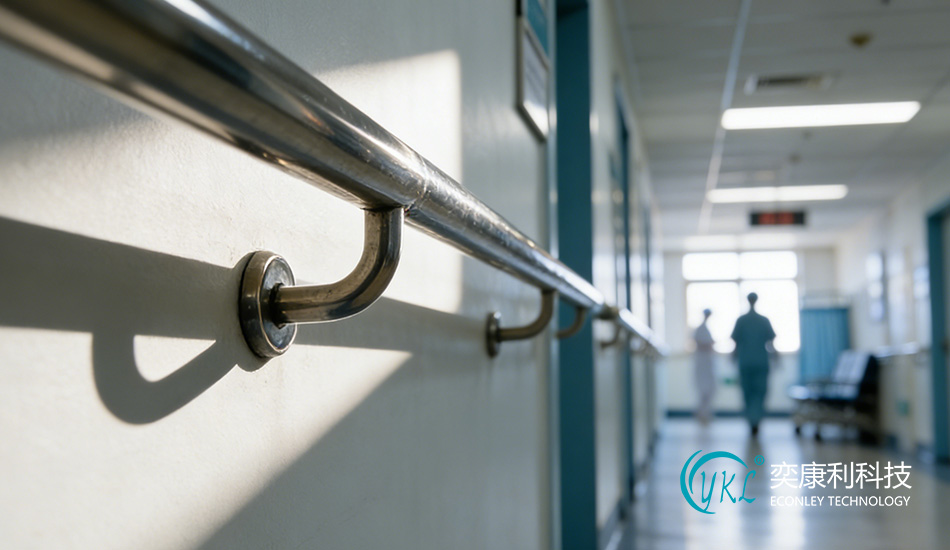
Brackets are the strong metal supports that connect the handrail to the wall studs. They are the crucial link that ensures the rail can support you when you need it most.
Proper bracket spacing is key to a stable rail. Place one bracket every 32 to 48 inches, screwing each one directly into a stud. For maximum stability, the first and last brackets should also be positioned just a few inches from the ends of the rail.
DIY handrail installation kits often include the right number of supports, and you can find many modern bracket styles to suit your home's decor. As a quick guide:
6-foot rail: 3 brackets
8-foot rail: 3-4 brackets
12-foot rail: 4-5 brackets
With the rail now firmly supported, the final safety detail involves the ends of the rail itself.
Ever had your sleeve or a bag strap get caught on the blunt end of a handrail? To prevent this dangerous snag, the rail’s end should smoothly curve back to meet the wall or a post. This simple but critical safety feature is called a handrail return.
This isn't just a style choice; it's a fundamental safety measure mandated by most stair handrail building codes. The logic is to eliminate any projection that could catch clothing, which could turn a simple stumble into a serious fall. An open-ended rail is a hidden hazard waiting to happen.
Whether you're evaluating a contractor's work or looking at examples for inspiration, a proper return is the ultimate sign-off on a safe, professional-quality job. It’s a small detail that provides significant peace of mind.
Now you can assess any railing with an expert eye. Use this simple 4-Point Safety Check when vetting a professional's work or inspecting your own:
The Shake Test: Is it rock-solid? (Checks for stud mounting)
The Height Test: Is it 34-38 inches high? (Checks for correct height
The Grip Test: Is there 1.5” of handspace? (Checks for clearance)
The Snag Test: Do the ends curve to the wall? (Checks for returns)
This checklist helps you turn installation ideas into reality or finally fix a wobbly railing. With this knowledge, you can ensure your staircase is safer for everyone, one solid handhold at a time.
 Tel :13510328459
 Email :493432861@qq.com
 Phone :0755-82154850/25907050
 Add:205-206, 2nd Floor, Building 2, Xiazao Village Industrial Zone, Gaofeng Community, Dalang Street, Longhua District, Shenzhen City

About

Products
Cases
News
Contact
 493432861@qq.com