Service Hotline:13510328459
 205-206, 2nd Floor, Building 2, Xiazao Village Industrial Zone, Gaofeng Community, Dalang Street, Longhua District, Shenzhen City
Service Hotline:13510328459
205-206, 2nd Floor, Building 2, Xiazao Village Industrial Zone, Gaofeng Community, Dalang Street, Longhua District, Shenzhen City



Time:2026-01-04 Preview:
Kindergartens are lively collective activity spaces for toddlers aged 3-6, a group with unique characteristics—short stature, poor balance, lively and active personalities, and weak self-protection awareness. Accidental collisions (such as bumping into walls, falling during group activities, or being hit by peers) are one of the most common safety hazards in kindergartens. The Kindergarten Special Anti-Collision Handrail has emerged as a core safety facility for kindergarten construction, designed to target the collision risks of collective toddler activities through professional anti-collision technology and child-friendly design. Unlike ordinary children’s handrails that focus only on basic support, the Kindergarten Special Anti-Collision Handrail integrates enhanced anti-collision performance, collective activity adaptation, and easy-to-manage features, ensuring every toddler can move and play safely in the campus. As a professional provider of kindergarten safety facility solutions, we integrate Kindergarten Special Anti-Collision Handrail with core child-safe products such as anti-slip flooring, rounded-edge activity tables, and soft playground mats, delivering comprehensive safety optimization for kindergarten collective activity spaces. This article explores the core value, kindergarten scenario adaptation, child-friendly design, and procurement criteria of Kindergarten Special Anti-Collision Handrail, offering practical guidance for kindergarten administrators and procurement teams.
The primary value of Kindergarten Special Anti-Collision Handrail lies in targeted anti-collision protection for toddlers. Toddlers are prone to running and chasing in corridors, activity rooms, and other areas, making collisions with walls or handrail structures inevitable. The Kindergarten Special Anti-Collision Handrail adopts a soft, high-buffer outer layer and a sturdy inner support structure—when a toddler collides with it, the buffer layer can effectively absorb impact force, minimizing the risk of bruises, swelling, or other injuries. Additionally, it serves as a stable support for toddlers with poor balance, helping them maintain stability during walking, climbing stairs, or transitioning between activities, further reducing fall and collision risks.
Another key value is adapting to kindergarten collective activity needs and optimizing operational management. Kindergartens feature dense toddler flow and frequent group activities; the Kindergarten Special Anti-Collision Handrail is designed with continuous installation and appropriate spacing to avoid obstructing the movement of large groups of children. Its surface is easy to clean and disinfect, adapting to the high-frequency hygiene management requirements of kindergartens. For kindergartens, equipping with professional Kindergarten Special Anti-Collision Handrail also reflects the institution’s focus on toddler safety, enhances the quality of childcare services, and strengthens parents’ trust in the kindergarten’s safety management capabilities.
Kindergarten Special Anti-Collision Handrail provides targeted adaptation solutions for the core functional zones of kindergartens, ensuring full-scenario safety coverage. In corridors—the main channel for collective activities—continuous handrails are installed on both sides, with a height customized to 60-70cm (matching the average height of 3-6-year-old toddlers). The outer layer is made of food-grade soft rubber material to avoid injury from collisions. The handrail is installed 5-8cm away from the wall to form a buffer gap, preventing toddlers from being pinched when leaning against the wall.
In activity rooms and classrooms, the Kindergarten Special Anti-Collision Handrail is installed along the edges of walls, activity shelves, and teaching aids. It is designed with a curved structure at corners to eliminate sharp edges, avoiding scratches when toddlers run around. In nap rooms, the handrail is installed beside cots and along the walkway, with a softer buffer layer to avoid disturbing sleeping toddlers when collisions occur. In bathrooms—a humid and slippery high-risk area—the handrail adopts a moisture-proof, corrosion-resistant buffer material, and the surface is treated with anti-slip coating. It is installed around toilets and sinks to provide support for toddlers during handwashing and toileting, while preventing collisions with hard bathroom walls.
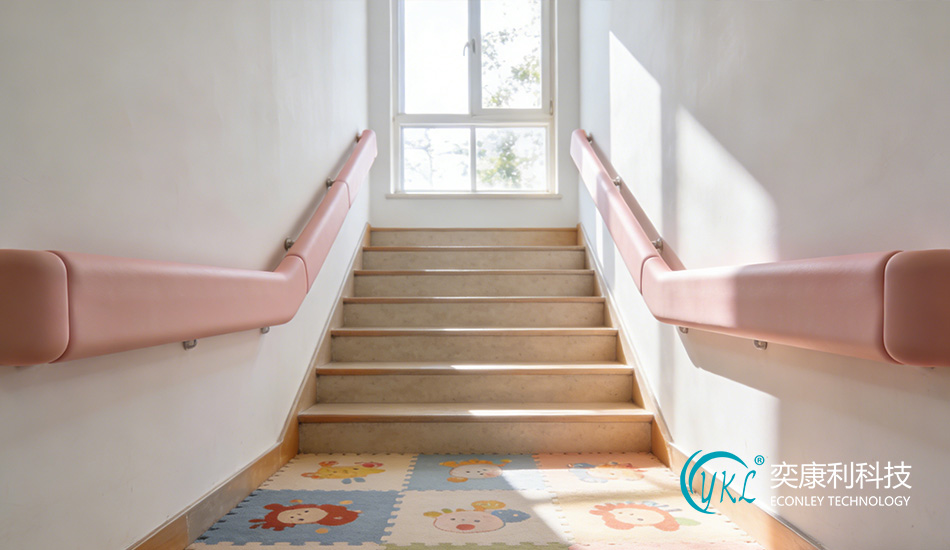
High-quality Kindergarten Special Anti-Collision Handrail integrates rich child-friendly design elements to enhance toddler acceptance and safety. In terms of appearance, it adopts bright, soft colors (such as pastel pink, sky blue, and mint green) that conform to toddlers’ aesthetic preferences, and can be printed with simple, cute patterns (such as small animals, stars) to attract toddlers’ attention and guide them to use the handrail correctly. The grip surface is designed with a concave-convex non-slip texture, which is easy for toddlers with weak grip strength to hold firmly.
In structural design, all connection points of the handrail are fully enclosed to avoid gaps that may trap toddlers’ fingers. The overall structure is sturdy and stable, able to withstand the pulling, shaking, and collision of multiple toddlers at the same time. Additionally, the handrail is designed with detachable local segments, facilitating the adjustment of installation positions according to the replacement of teaching aids and activity layouts in the kindergarten, improving the flexibility of use.
Professional Kindergarten Special Anti-Collision Handrail strictly complies with international and national kindergarten safety standards, such as EN 14411 (European Standard for Children's Playground Equipment and Surfacing), ASTM F1487 (American Standard for Public Playground Safety), and local kindergarten facility safety codes. These standards specify strict requirements for the anti-collision performance, material safety, and structural stability of handrails used in kindergartens, ensuring that products are harmless to toddlers’ health and can effectively resist collision risks.
In terms of material selection, the handrail uses food-grade, non-toxic, and odorless soft materials that meet medical standards, avoiding harmful substances such as formaldehyde and heavy metals. Before leaving the factory, it undergoes rigorous tests such as impact resistance, wear resistance, and toxic substance detection. Reputable suppliers provide complete compliance documents, including material safety test reports, anti-collision performance test reports, and non-toxic certification, facilitating kindergarten safety audits and regulatory inspections.
When procuring Kindergarten Special Anti-Collision Handrail, kindergarten teams should focus on three core criteria: anti-collision performance, scenario adaptability, and safety compliance. Firstly, prioritize products with proven anti-collision capabilities, verifying through test reports that the buffer layer can effectively absorb impact force and reduce injury risks. Avoid products with hard surfaces or insufficient buffer performance.
Secondly, match the handrail’s design to kindergarten scenarios: choose continuous installation models for corridors, curved corner models for classrooms, and moisture-proof corrosion-resistant models for bathrooms. Consider the density of toddler activities and select handrails that do not obstruct group movement. Finally, verify the supplier’s professional qualifications in kindergarten safety products, including relevant certifications and successful cases in kindergarten projects. Choose suppliers who can provide on-site installation guidance and after-sales maintenance services to ensure the handrail’s long-term safe use.
Kindergarten Special Anti-Collision Handrail is a critical safety barrier for protecting toddlers’ healthy growth in collective activity spaces, directly related to the safety of every child and the reputation of the kindergarten. By selecting professional, scenario-adaptive Kindergarten Special Anti-Collision Handrail, kindergartens can create a safer, more reassuring environment for toddlers to grow and play. If you are a kindergarten administrator or procurement team seeking high-quality Kindergarten Special Anti-Collision Handrail and integrated kindergarten safety solutions, contact us today. We will provide personalized product recommendations, complete safety certification documents, and professional technical support, helping you build a safer and more caring kindergarten environment.
 Tel :13510328459
 Email :493432861@qq.com
 Phone :0755-82154850/25907050
 Add:205-206, 2nd Floor, Building 2, Xiazao Village Industrial Zone, Gaofeng Community, Dalang Street, Longhua District, Shenzhen City

About

Products
Cases
News
Contact
 493432861@qq.com