Service Hotline:13510328459
 205-206, 2nd Floor, Building 2, Xiazao Village Industrial Zone, Gaofeng Community, Dalang Street, Longhua District, Shenzhen City
Service Hotline:13510328459
205-206, 2nd Floor, Building 2, Xiazao Village Industrial Zone, Gaofeng Community, Dalang Street, Longhua District, Shenzhen City



Time:2026-02-03 Preview:
For facility managers, healthcare contractors, and architects, the installation of a corridor handrail is not merely a finishing touch—it is a critical safety intervention and a legal necessity. As we move into 2026, the standards for accessibility and infection control in high-traffic medical environments have become more stringent than ever.
Whether you are outfitting a new surgical center or retrofitting an elderly care facility, understanding the nuances of Nursing Home Corridor Handrail systems and Hospital Corridor Handrail compliance is essential to avoid costly building code violations and, more importantly, to ensure patient safety.
In elderly care environments, mobility is the primary challenge. A Nursing Home Corridor Handrail serves a dual purpose: it provides continuous physical support for residents with limited balance and acts as a protective buffer for the walls against heavy equipment like wheelchairs and motorized carts.
For seniors, the presence of a sturdy corridor handrail reduces the fear of falling, which encourages movement and physical activity. In nursing homes, these rails are often designed with a "comfortable grip" profile, ensuring that residents with arthritis or weakened grip strength can maintain a secure hold.
Unlike residential railings, corridor handrails nursing homes utilize often feature an integrated "bumper" or "crash rail." This design prevents the expensive wall damage caused by daily operations, such as laundry carts or food trolleys hitting the plasterboard.
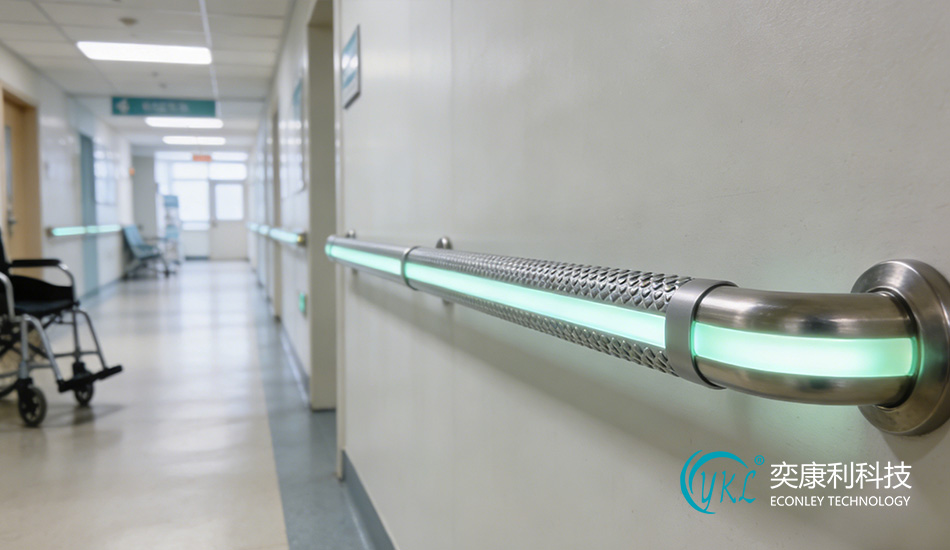
Hospitals are high-impact environments. A hospital corridor handrail must meet rigorous standards for weight-bearing capacity, fire safety, and hygiene. Compliance with ADA (Americans with Disabilities Act) and local building codes is non-negotiable.
The standard hospital corridor handrail must be able to withstand significant impact. In a trauma center or ER, beds and heavy diagnostic machines are moved at high speeds. A hospital corridor pvc handrail with an internal aluminum core is the industry gold standard, offering the resilience of metal with the shock-absorption of high-grade polymers.
Modern healthcare corridor handrails are high-touch surfaces. Therefore, the material must be non-porous and resistant to harsh chemical disinfectants. Many manufacturers, including Econley, now integrate antimicrobial agents directly into the PVC cover to inhibit the growth of bacteria and viruses on the rail surface.
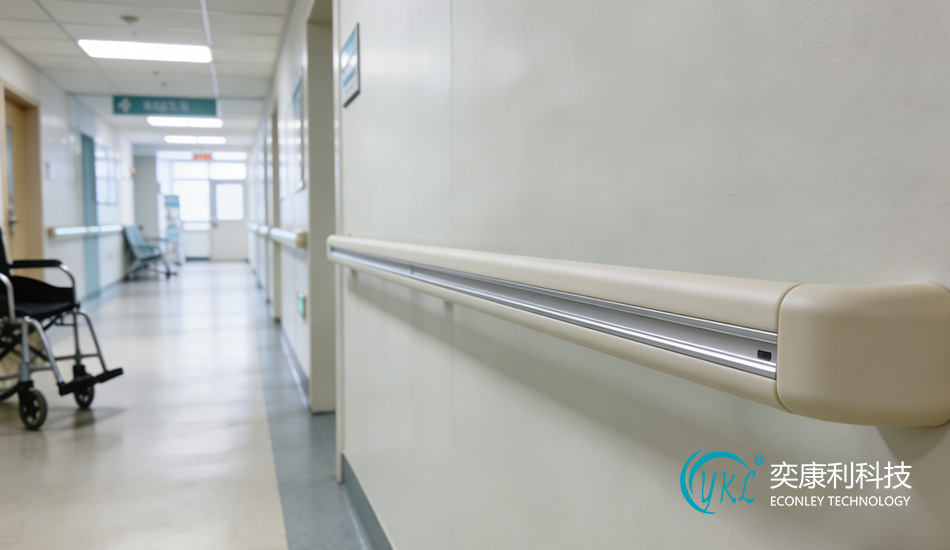
Designing an effective system requires precise attention to measurements. A minor deviation in the corridor handrail height can result in a failed inspection.
According to ADA and international safety standards:
Standard Height: The hospital corridor handrail height should be mounted between 34 inches and 38 inches (865 mm – 965 mm) above the finished floor.
Wall Clearance: There must be a clear space of at least 1.5 inches (38 mm) between the handrail and the wall to allow for a proper hand grip without the risk of scraping knuckles.
Diameter: The gripping surface should have an outside diameter between 1.25 inches and 1.5 inches for circular rails, or a maximum cross-section of 2.25 inches for non-circular designs.
While stainless steel is common, the hospital corridor pvc handrail is increasingly preferred for several reasons:
Warmth to Touch: PVC does not conduct cold like metal, which is more comfortable for elderly patients.
Color Coding: Available in various colors to assist in "wayfinding" (e.g., blue rails for the cardiology wing, green for oncology).
Cost-Effectiveness: It offers superior protective corridor handrails functionality at a lower price point than full-metal systems.
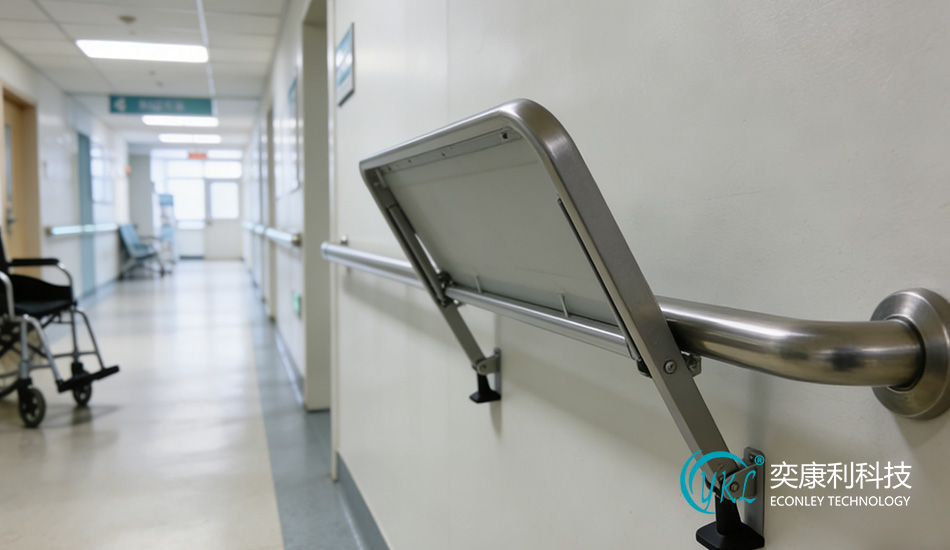
In a busy corridor, the handrail is part of a larger "Wall Protection System." Strategic corridor handrail design often includes:
Return-to-Wall Ends: The ends of the rails must turn back into the wall or terminate smoothly to prevent clothing or equipment from snagging.
Anti-Ligature Options: For psychiatric wards or behavioral health units, the gap between the rail and the wall is closed to prevent self-harm risks.
Heavy-Duty Brackets: Brackets must be spaced correctly (typically every 30-32 inches) to support a concentrated load of at least 200 lbs.
At Econley, we manufacture corridor handrails that bridge the gap between aesthetic design and industrial strength. Our systems are engineered for easy installation, reducing labor costs for contractors while ensuring total compliance with hospital corridor handrail requirements.
Engineered Aluminum Core: Every rail is reinforced with a high-strength 6063-T5 aluminum alloy.
Impact-Resistant Vinyl Covers: Our PVC covers are fire-rated, lead-free, and available in over 20 colors.
Complete Component Kits: We provide matching end caps, outside/inside corners, and heavy-duty brackets to ensure a seamless look.
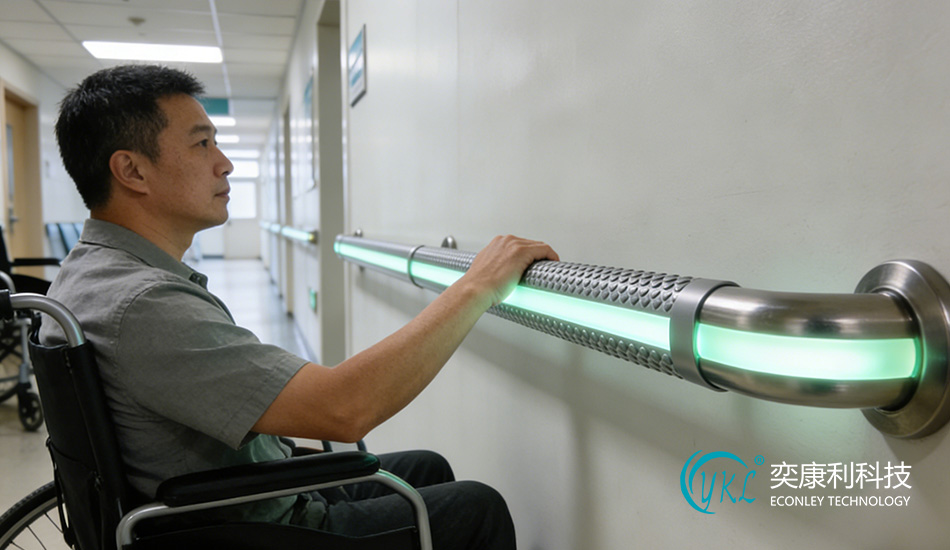
The corridor handrail height must be consistent and positioned between 34 and 38 inches from the walking surface. At Econley, our mounting brackets are adjustable to ensure installers can maintain this exact height even if the floor is slightly uneven.
A combination of an aluminum retainer and a high-impact PVC or vinyl cover is best. This provides the structural integrity required by hospital corridor handrail requirements while offering a surface that is easy to sanitize and soft to the touch.
Yes, ADA standards generally require handrails to be continuous along the full length of the corridor. Any breaks should be minimal and only occur at doorways or changes in direction. Econley’s system includes specialized connectors to maintain a smooth, uninterrupted gripping surface.
Absolutely. Most protective corridor handrails are designed with a wider profile specifically to act as a bumper for hospital beds and carts, protecting the expensive wall finishes behind them.
Related content
Corridor anti-collision handrails
 Tel :13510328459
 Email :493432861@qq.com
 Phone :0755-82154850/25907050
 Add:205-206, 2nd Floor, Building 2, Xiazao Village Industrial Zone, Gaofeng Community, Dalang Street, Longhua District, Shenzhen City

About

Products
Cases
News
Contact
 493432861@qq.com